Chapter 13: The Eight Levers
Thesis: The eight moves are not an arbitrary list. Each one pulls a different lever in the decomposition of risk and information, and that is why the set feels "complete."
Part III delivered the table: eight moves in four pairs, turning up again and again under different jargon in four concrete settings and in science. But a list, however tidy, is still only a list. This chapter presses on one question. Why these eight, and not others? Did I simply assemble them, or does each one occupy a position it could not have avoided? If each does, the convergence has been explained. If not, this book is at best a handy manual of classification.
I want to offer a candidate explanation. The uncomfortable part comes first: it is an organizing scheme, not a proof. Once you have read it, hold it up to the skepticism that Chapter 14 will bring.
A Rough Breakdown of Risk
Strip "acting when you cannot verify" down to its barest form, and what you are really managing is risk. In the old language of decision theory (Wald1, Savage4, von Neumann and Morgenstern3), risk can be written, roughly, as
$$\text{Risk}\ \approx\ \Pr(\text{fail})\ \times\ \text{Cost}(\text{fail}),$$
and all of it happens under an information budget $B$. The checks, samples, computation, and time you can spend to reduce uncertainty are all finite.
The formula looks simple, but the point is this: its right-hand side offers only a few places to intervene, few enough to count. You can change what counts as "failure" in the first place. You can change the probability of failure, or what you know about that probability. You can change the cost of failure, how you spend the information budget, or when the checking happens. My claim is that the eight moves occupy one position apiece, with no ninth slot left to fill.
Eight Moves, Eight Positions
Here is each move matched to the lever it pulls:
| Move | The lever it pulls | Where it acts in the decomposition of risk |
|---|---|---|
| proxy substitution | changes the target you measure and optimize | redefines "failure" itself |
| certificate / bound | reduces uncertainty on one slice to a guaranteed bound | pushes $\Pr(\text{fail})$ close to zero locally |
| oracle in the loop | brings in checking power you do not have on your own | lowers $\Pr(\text{fail})$ with outside help |
| redundancy / consensus | keeps several judgments from failing together | lowers the joint failure probability $\Pr(\text{all\ fail})$ |
| optimal screening | spends the information budget where the marginal return is highest | allocates $B$ to cut uncertainty as much as possible |
| calibration | puts an honest price on residual risk | makes $\Pr(\text{fail})$ known, so you can bet on it |
| containment / fencing | shrinks the blast radius | lowers $\text{Cost}(\text{fail})$ |
| audit trail | moves checking from before the fact to after it | changes when checking happens, turning an unrecoverable failure into a recoverable one |
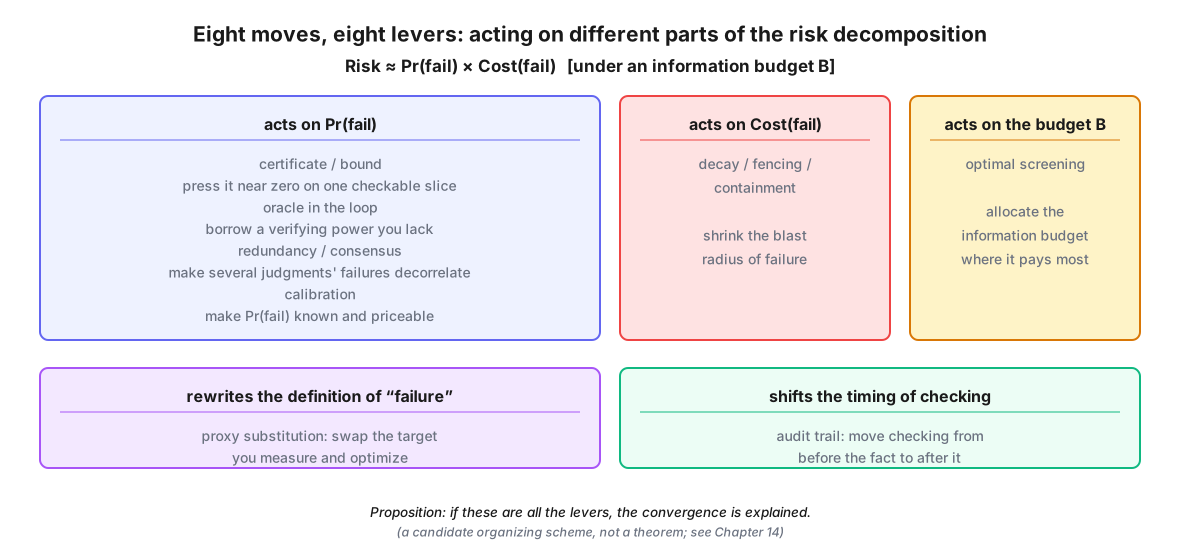
Read through the table, and the sense that this is just "an assembled list" should loosen a little. The eight moves are not eight tools picked up at random. Between them they cover $\Pr$, knowledge of $\Pr$, cost, budget allocation, the timing of checks, and the definition of the target. That fills nearly every place where the decomposition can be acted on. The claim can then be put this way. If these really are all the levers there are, the set of moves is complete, and that explains the convergence: any competent actor will sooner or later rediscover them, because there is nothing else to pull.
Why Carbon, Silicon, and Organizations All Converge
If this holds, it also explains the puzzle the book opened with: why mathematicians, engineers, and organizations reach for the same eight moves without ever having agreed to.
In his study of vision, Marr17 distinguished three levels. The computational level concerns what problem is being solved, and under what constraints. The algorithmic level concerns what representations and processes are used. The implementational level concerns what hardware it all runs on. The eight moves live at the computational level. They answer the question "if you cannot verify, which few places are still logically open to action?" That answer does not depend on whether you are a carbon-based mathematician, a silicon-based program, or a bureaucracy made of people. The implementations vary wildly, but the constraint at the computational level is the same, so the responses converge. Simon's bounded rationality12 and his "sciences of the artificial"13 describe this kind of behavior: shaped by the constraints of the environment, not by the internal makeup of the actor.
The no free lunch theorem (Wolpert and Macready25) belongs here too. It says that, averaged over all possible problems, no method outperforms any other. This cuts both ways. On one hand, it supports the book's restraint. There is no universal solution, and you have to rely on the specific structure of a problem to choose a lever, which is why the five faces must be treated separately. On the other hand, it is a warning. Anyone who claims to have "found the unifying key," myself included, should keep their pride in check. And when you cannot even pin down the probability of failure, the levers come in robust versions. Gilboa and Schmeidler's maxmin expected utility20, Hansen and Sargent's robust control30, and decision-making under Knightian uncertainty are all moves that still mount a defense against the worst case even when $\Pr$ itself is ambiguous.
A Strong Claim, and Its Limits
Now for the uncomfortable part, in full.
The scheme above is a candidate organizing structure, not a theorem. The decomposition of risk is informal. I have given no rigorous model of the actor and the environment, so I cannot prove that the optimal strategy comes down to exactly these eight levers. "These are all the levers there are" is an assertion, not an established result. I have no evidence that the table is exhaustive. Nor can I rule out that it is just a framework built after the fact, a story flexible enough to fit many different sets of moves. Some of the assignments in the table even overlap. Redundancy, for instance, lowers joint failure but also looks like a special kind of screening. That overlap alone shows the decomposition is not yet clean.
I include it because it has organizing power and explanatory appeal, not because it has been proved. It meets the standard of a good conjecture: it is clear, it can be refuted, and it unifies a large body of phenomena. But it has not yet risen to the level of a theorem.
That makes the final question unavoidable. Is this convergence across fields a law, forced by something? Or is it a strong pattern that is, in the end, only empirical? The next chapter takes that question on directly.
References
Waypoints: 1. historical scientific judgment; 2. theoretically studied material; 3. how science progresses; 4. how to live in an unverifiable world. This section was checked source by source.
- A. Wald (1950). Statistical Decision Functions. John Wiley & Sons. Google Books [2][4] Wald recast statistical inference as a decision problem against nature: the decision-maker must choose a strategy under risk (the expectation of loss), using the minimax criterion of minimizing the maximum risk to cope with the unknown state. This book founded statistical decision theory, and the scholarly root of this chapter's crude decomposition, "risk is roughly failure probability times cost," lies right here.
- A. Wald (1939). "Contributions to the Theory of Statistical Estimation and Testing Hypotheses." The Annals of Mathematical Statistics, 10(4), 299-326. doi:10.1214/aoms/1177732144 [2] This is Wald's early paper unifying estimation and testing within a loss-function framework, preceding his later monograph, already introducing the ideas of a risk function and a least favorable prior. It marks the starting point of the turn toward "talking about statistics in the language of decision," and is valuable for understanding why this chapter draws on decision theory.
- J. von Neumann and O. Morgenstern (1944). Theory of Games and Economic Behavior. Princeton University Press. Google Books [2] Von Neumann and Morgenstern founded game theory and derived the expected utility theorem from a set of axioms: preferences satisfying the rationality axioms can be represented as maximizing the expectation of a utility. This is the normative baseline for "betting under uncertainty," cited here as one source of the chapter's calculus of risk.
- L. J. Savage (1954). The Foundations of Statistics. John Wiley & Sons. Google Books [2][4] Savage, using a set of axioms about preferences over actions, derived subjective probability and utility together, building Bayesian decision theory on personalist probability. It is the founding work of the modern framework of "subjective probability plus expected utility," and also the target that Ellsberg's paradox later challenges.
- F. H. Knight (1921). Risk, Uncertainty and Profit. Houghton Mifflin. Google Books [2] Knight distinguished quantifiable "risk" from "uncertainty" to which no probability can be assigned, and argued that entrepreneurial profit comes precisely from bearing the latter. This distinction is the key conceptual source when this chapter speaks of "cannot even pin down the probability of failure," and Knightian uncertainty runs through the later series of robust decision works.
- J. M. Keynes (1921). A Treatise on Probability. Macmillan. Google Books [2] Keynes developed a logical interpretation of probability, treating it as a rational degree of belief between propositions, and stressed that many probabilities are neither numerical nor necessarily comparable. It laid the groundwork for later non-additive, imprecise probabilities, reminding the reader that the epistemic status of probability itself is far more complex than any formula.
- F. P. Ramsey (1931). "Truth and Probability." The Foundations of Mathematics and other Logical Essays (R. B. Braithwaite, ed.). Kegan Paul, Trench, Trubner & Co., 156-198. Google Books [2] Ramsey was the first to argue that a person's degree of belief can be measured operationally through their betting behavior, and that avoiding a sure-loss combination (a Dutch book) requires those degrees of belief to obey the axioms of probability. This is the founding work of subjective probability, and it provides the philosophical and operational basis for this chapter's "putting a truthful price on residual risk."
- B. de Finetti (1937). "La prévision: ses lois logiques, ses sources subjectives." Annales de l'Institut Henri Poincaré, 7(1), 1-68. link [2] De Finetti proposed subjective probability and backed it with the Dutch-book argument and the representation theorem for exchangeability, arguing that probability is "only" a coherent personal degree of belief. Together with Ramsey it forms the cornerstone of Bayesianism, an essential source for understanding calibration and honest pricing.
- F. J. Anscombe and R. J. Aumann (1963). "A Definition of Subjective Probability." The Annals of Mathematical Statistics, 34(1), 199-205. doi:10.1214/aoms/1177704255 [2] The two authors, by introducing objective randomizing devices (such as roulette lotteries), gave an axiomatization of subjective probability and utility more compact than Savage's. This framework later became the standard stage for ambiguity decision theory, and the several ambiguity-aversion works cited in this chapter are built upon it.
- D. Ellsberg (1961). "Risk, Ambiguity, and the Savage Axioms." The Quarterly Journal of Economics, 75(4), 643-669. doi:10.2307/1884324 [2] Ellsberg used two famous ball-drawing experiments to show that people systematically prefer known probabilities and avoid "ambiguity," a behavior that violates Savage's axioms and cannot be explained by any single subjective probability. It established ambiguity as an independent phenomenon, and is the direct motivation for the subsequent robust and multiple-prior theories.
- R. D. Luce and H. Raiffa (1957). Games and Decisions: Introduction and Critical Survey. John Wiley & Sons. Google Books [2][4] This book is a classic introduction to, and critical survey of, game theory and decision theory, both laying out expected utility and game solution concepts clearly and candidly discussing the limits of applicability of each axiom. It suits the reader as a general entry point into the chapter's decision-theoretic background, at once systematic and critical.
- H. A. Simon (1955). "A Behavioral Model of Rational Choice." The Quarterly Journal of Economics, 69(1), 99-118. doi:10.2307/1884852 [2] Simon here proposed bounded rationality and "satisficing": an actor limited by cognition and information does not seek the global optimum, but searches until it finds an option good enough and then stops. This is the core support for this chapter's argument that "constraints at the computational level shape behavior," explaining why different kinds of actor converge on the same set of responses.
- H. A. Simon (1969). The Sciences of the Artificial. MIT Press. Google Books [2][3] Simon argued that the behavior of an artifact is determined more by the constraints of the environment it inhabits than by its internal construction, and called for founding "design" as a discipline of artificial systems. This chapter draws on it to argue that the eight moves live at Marr's computational level, being shaped by the constraints of the environment rather than the internal makeup of the actor.
- K. R. Popper (1959). The Logic of Scientific Discovery. Hutchinson. Google Books [2][3] Popper systematically proposed falsificationism: a scientific theory cannot be empirically verified, only refuted, so falsifiability becomes the line between science and non-science. When this chapter admits at the close that its decomposition "rises to a good conjecture but not yet to a theorem," it is using precisely this measure of refutability.
- A. Tversky and D. Kahneman (1974). "Judgment under Uncertainty: Heuristics and Biases." Science, 185(4157), 1124-1131. doi:10.1126/science.185.4157.1124 [2] Tversky and Kahneman documented the heuristics people use in judging probability (representativeness, availability, anchoring) and the systematic biases they bring. It shows how real actors deviate from the Bayesian ideal, forming a contrast with moves such as calibration and optimal screening that require an honest estimate of probability.
- D. Kahneman and A. Tversky (1979). "Prospect Theory: An Analysis of Decision under Risk." Econometrica, 47(2), 263-291. doi:10.2307/1914185 [2] Prospect theory holds that people evaluate outcomes by gains and losses relative to a reference point, rather than by final wealth, are more sensitive to losses, and distort probability weights in a nonlinear way. It is a descriptive correction to expected utility, reminding the reader that cost and probability do not multiply neutrally in real decisions.
- D. Marr (1982). Vision: A Computational Investigation into the Human Representation and Processing of Visual Information. W. H. Freeman. Google Books [2][3] Marr proposed three levels for analyzing an information-processing system: the computational level (what problem is to be solved), the algorithmic level (what representations and processes are used), and the implementational level (what hardware it runs on). This chapter draws on exactly this hierarchy to argue that the eight moves live at the computational level and can therefore cross carbon-based, silicon-based, and organizational implementations.
- J. O. Berger (1985). Statistical Decision Theory and Bayesian Analysis. Springer-Verlag. doi:10.1007/978-1-4757-4286-2 [2][4] Berger systematically organized the statistical decision theory at the meeting point of the Bayesian and frequentist schools, covering loss functions, risk, admissibility, and robust Bayesian analysis. It is the standard reference for grounding this chapter's informal decomposition of risk in rigorous statistical language.
- D. E. Bell, H. Raiffa and A. Tversky (eds.) (1988). Decision Making: Descriptive, Normative, and Prescriptive Interactions. Cambridge University Press. doi:10.1017/cbo9780511598951 [2][4] This collection is organized around three orientations in decision research: descriptive (how people actually decide), normative (how rationality ought to proceed), and prescriptive (how to help people decide better), and discusses how the three interact. It gives the reader a map for placing the work of each school, echoing this chapter's repeated weighing between the normative and the empirical.
- I. Gilboa and D. Schmeidler (1989). "Maxmin Expected Utility with Non-Unique Prior." Journal of Mathematical Economics, 18(2), 141-153. doi:10.1016/0304-4068(89)90018-9 [2][4] Gilboa and Schmeidler gave an axiomatization for ambiguity decision-making: the actor holds a set of priors and evaluates an action by the least favorable among them, that is, a maxmin expected utility over the set of priors. This is exactly the move this chapter describes as "still mounting a defense against the worst case even when $\Pr$ itself is ambiguous," a representative formalization of robust decision-making.
- D. Schmeidler (1989). "Subjective Probability and Expected Utility without Additivity." Econometrica, 57(3), 571-587. doi:10.2307/1911053 [2] Schmeidler introduced non-additive subjective probability (capacities) and the corresponding Choquet expected utility, making ambiguity aversion representable in a consistent way. Together with the preceding entry it is a founding work of ambiguity decision theory, loosening, along another technical route, the constraint that probability must be additive.
- P. Walley (1991). Statistical Reasoning with Imprecise Probabilities. Chapman and Hall. doi:10.1007/978-1-4899-3472-7 [2][4] Walley systematically developed the theory of imprecise probabilities, characterizing belief under insufficient evidence with upper and lower probabilities (or a set of probabilities), and gave the corresponding criteria for coherence and inference. It provides a complete statistical language for the predicament of "cannot even pin down the probability," and is the deep theoretical backing for the calibration and robustness lines of thought.
- G. Gigerenzer and D. G. Goldstein (1996). "Reasoning the Fast and Frugal Way: Models of Bounded Rationality." Psychological Review, 103(4), 650-669. doi:10.1037/0033-295x.103.4.650 [2] Gigerenzer and Goldstein argued that simple "fast and frugal" heuristics can, in real environments, often match or even outperform complex models, exhibiting a kind of ecological rationality. It completes Simon's bounded rationality from the positive side, explaining why simple rules may be exactly the reasonable choice when the information budget is limited.
- D. H. Wolpert (1996). "The Lack of A Priori Distinctions between Learning Algorithms." Neural Computation, 8(7), 1341-1390. doi:10.1162/neco.1996.8.7.1341 [2] Wolpert proved the no free lunch result for supervised learning: averaged over all possible target functions, any learning algorithm has the same generalization performance. It shows that there is no universal learner independent of problem structure, and is the source, on the learning side, of this chapter's no free lunch argument.
- D. H. Wolpert and W. G. Macready (1997). "No Free Lunch Theorems for Optimization." IEEE Transactions on Evolutionary Computation, 1(1), 67-82. doi:10.1109/4235.585893 [2] Wolpert and Macready extended no free lunch to optimization: averaged over all possible objectives, no optimization algorithm outperforms another. This chapter uses this double-edged knife both to support the restraint that "one must lean on problem structure to choose a lever" and to warn anyone claiming to have found the unifying key to rein in their pride.
- I. Gilboa and D. Schmeidler (2001). A Theory of Case-Based Decisions. Cambridge University Press. doi:10.1017/cbo9780511493539 [2][4] The two authors proposed case-based decision theory: when an actor cannot articulate the state space and probability is out of the question, decisions can be driven by recall of and analogy to past similar cases. It provides another normative model for the predicament in which the probability framework breaks down entirely, broadening this chapter's imagination of how deep "unverifiable" can go.
- T. F. Bewley (2002). "Knightian Decision Theory. Part I." Decisions in Economics and Finance, 25(2), 79-110. doi:10.1007/s102030200006 [2][4] Bewley formalized Knightian uncertainty as the incompleteness of preferences: when the evidence is insufficient to rank two options, the actor may decline to choose, supplemented by an inertia assumption that maintains the status quo. It gives a clean axiomatic expression to "uncertainty that cannot be priced," and is the modern continuation of this chapter's Knightian theme.
- P. Klibanoff, M. Marinacci and S. Mukerji (2005). "A Smooth Model of Decision Making under Ambiguity." Econometrica, 73(6), 1849-1892. doi:10.1111/j.1468-0262.2005.00640.x [2] The three authors proposed a "smooth" model of ambiguity decision-making: by layering a further utility function over a second-order distribution on priors, it separates ambiguity attitude from risk attitude and avoids the non-smooth kink of maxmin. It makes the degree of ambiguity aversion tunable and analyzable, a finer notch within the spectrum of robust decision-making.
- F. Maccheroni, M. Marinacci and A. Rustichini (2006). "Ambiguity Aversion, Robustness, and the Variational Representation of Preferences." Econometrica, 74(6), 1447-1498. doi:10.1111/j.1468-0262.2006.00716.x [2][4] The authors gave the unified representation of variational preferences, gathering maxmin expected utility, multiplier (robust control) preferences, and others as special cases, with ambiguity attitude characterized by a penalty term on deviation. It mathematically links the several robust moves mentioned in this chapter into one family, its value lying in revealing their common skeleton.
- L. P. Hansen and T. J. Sargent (2008). Robustness. Princeton University Press. doi:10.1515/9781400829385 [2][4] Hansen and Sargent brought robust control from control theory into economic decision-making: the decision-maker distrusts the model in hand and so optimizes against the least favorable among a family of nearby models, seeking robustness to specification error. This is the main source of this chapter's "robust control" move, displaying a dynamic form of mounting a defense against the worst case.
- P. P. Wakker (2010). Prospect Theory: For Risk and Ambiguity. Cambridge University Press. doi:10.1017/cbo9780511779329 [2] Wakker systematized and axiomatized prospect theory, handling decision weights under risk and ambiguity in a unified way, and provided operational methods of measurement. It stitches descriptive prospect theory together with normative ambiguity theory, and is the authoritative monograph for the reader going deeper into the theme of probability weighting.
- I. Gilboa and M. Marinacci (2013). "Ambiguity and the Bayesian Paradigm." Advances in Economics and Econometrics: Theory and Applications, Tenth World Congress (D. Acemoglu, M. Arellano and E. Dekel, eds.). Cambridge University Press. doi:10.1017/cbo9781139060011.008 [2][4] This survey traces the whole line of ambiguity decision-making and faces a fundamental question head-on: in what sense the Bayesian paradigm suffices, and where it needs to be replaced by models such as multiple priors. It is the best navigation into this chapter's cluster of ambiguity and robustness literature, and matches this chapter's restraint in attitude.
- P. Bossaerts and C. Murawski (2017). "Computational Complexity and Human Decision-Making." Trends in Cognitive Sciences, 21(12), 917-929. doi:10.1016/j.tics.2017.09.005 [2] The two authors argued that many real decision problems are intractable in computational complexity (such as the knapsack and other NP-hard problems), and that the brain's performance and strategies are shaped by this hard constraint. It provides hard evidence for bounded rationality from the angle of computational complexity, echoing this chapter's core claim that "constraints at the computational level force convergence."