Chapter 2: The Five Faces of Unverifiability
Thesis: "I cannot check it" hides five structurally different situations, and running them together is the central error in this field.
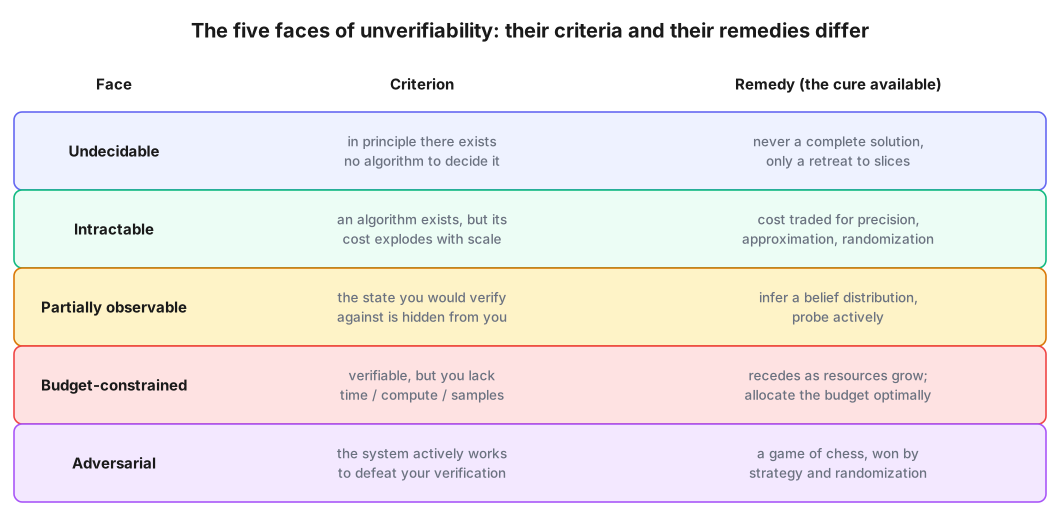
"I cannot check it" sounds like one situation, but it hides five. They differ in structure, and so do the remedies that work for each. Running them together is the field's central error.
This chapter pulls the five apart and pins each one down. That may look like nothing more than a taxonomist's fussiness, but the whole second half of the book draws on it. The book's eventual argument is that, however wildly the sources of unverifiability differ, the responses converge on the same small set. For that claim not to sound cheap, "wildly different" has to be made to stick first. The more sharply the differences are drawn, the more the later convergence becomes something to marvel at, something that needs explaining. Keep these five faces firmly in mind. They will come up again and again throughout the book.
The First Face: Undecidable
The criterion: in principle, no algorithm exists that can decide it. This is not a matter of difficulty. The algorithm does not exist.
This is the hardest way verification can fail. In 1928 Hilbert and Ackermann4 stated the decision problem (the Entscheidungsproblem) explicitly. They asked whether there could be a mechanical procedure that decides whether any mathematical statement is true or false. Eight years later, Church2, using the lambda calculus, and Turing1, using his abstract machine, each proved that there could not. Turing's halting problem is especially clean: no algorithm can decide, for an arbitrary program and input, whether the program will halt. Gödel's incompleteness theorem of 19313, Rice's theorem6 (no nontrivial semantic property of a program is decidable), and Matiyasevich's 1970 negative answer7 to Hilbert's tenth problem all belong to the same family. None of this is idle theory. The question "will this program do something harmful?" reduces to the halting problem, so in theory there can be no antivirus software that detects every malicious program without fail. Logic has set that ceiling for the entire antivirus industry.
The remedy for this face has a property no other face shares: there will never be a complete solution. More time will not help, and neither will a faster machine, because the obstacle is logical, not a shortage of resources. All you can do is settle for less. You verify a finite slice, or you restrict yourself to fragments that really are decidable (arithmetic with addition only, for example). This point will keep echoing all the way to Chapter 7.
The Second Face: Intractable
The criterion: an algorithm exists, but its cost explodes as the problem grows, until it is too large to finish in practice.
This face and the last are a hair apart and a world apart. The problem is decidable yet infeasible. NP-completeness, established independently by Cook in 19718 and Levin in 19739, together with Karp's famous twenty-one NP-complete problems of 197210, gives this face a precise description. Satisfiability and countless problems of combinatorial optimization all have solution methods in principle. But in the worst case, the time those methods take grows exponentially with the size of the input,
$$T(n)\sim 2^{n},$$
so a few dozen variables are enough to put the problem out of reach of the fastest supercomputer. For a sense of scale: the game tree of chess has about $10^{120}$ branches (the Shannon number), and Go has about $2\times10^{170}$ legal positions, while the entire observable universe contains only about $10^{80}$ atoms. These board games have simple rules and can be exhausted in principle, but that "in principle" lies far beyond what is physically possible. Whether $\mathsf{P}$ equals $\mathsf{NP}$ is the question of whether this wall is bound to stand forever.
The remedy here is completely different from the one for the undecidable. More resources actually help. More to the point, you can accept a little less in exchange for a cost you can afford. You use approximate answers instead of exact ones, the average case instead of the worst case, heuristic search, and randomization. Intractability has forced people to develop a whole craft of settling for a discount, and the undecidable offers nothing like it.
The Third Face: Partially Observable
The criterion: the state you would need to check against is hidden from you.
The trouble here is neither a missing procedure nor an excessive cost. You just cannot see what you need to see. A user's true preferences, what is happening inside a patient's body, the cards in an opponent's hand: these are the states that drive the outcome, and they do not reveal themselves to you. Control theory formalized this early. In 1965 Åström15 studied optimal control when information about the state is incomplete. Smallwood and Sondik in 197316, along with Kaelbling and colleagues in 199818, developed this into the standard framework of the partially observable Markov decision process (POMDP). In 1987 Papadimitriou and Tsitsiklis17 went further and proved that solving this class of problems is itself intractable. So the third face often compounds the second.
Its remedy is in a class of its own. You stop looking for a definite verdict. Instead you maintain a belief distribution over the hidden state (a belief state) and update it with each new observation:
$$b'(s')\ \propto\ \Pr(o\mid s')\sum_{s}\Pr(s'\mid s,a)\,b(s).$$
The cure for this face is inference and probing, not harder computation. All of Chapter 5 takes place inside it.
The Fourth Face: Budget-Constrained
The criterion: in principle it can be verified and solved, but you, this actor, here and now, lack the time, the computing power, or the samples.
This face is the plainest and also the most common. A reviewer has twenty minutes to read a paper. A doctor has a few minutes to make a diagnosis. A trader has to place an order before the quote disappears. Verification is entirely feasible in theory, but not once it falls to a bounded actor. The ideas behind this face come from Knight's distinction between risk and uncertainty in 192119 and Simon's bounded rationality in 195520. Its formal versions are Dean and Boddy's anytime algorithm of 198822 (one you can interrupt at any moment to get the best answer so far) and Russell and Subramanian's "bounded optimality" of 199523.
Its remedy has a feature no other face shares: this face recedes as resources grow. Give it enough time and computing power and it disappears. That is why the heart of dealing with it is allocation, spending a scarce budget where the marginal return is highest. This line of thinking is where the later move of optimal screening comes from.
The Fifth Face: Adversarial
The criterion: the system you face is actively working to defeat your verification.
In the first four faces, the difficulty comes from a neutral property of the world: logic, scale, visibility, or resources. The fifth is different. Across from you sits an intelligence that is optimizing against your checks. Think of the opponent who lies, the malicious code that disguises itself, the test-taker who games the metric. The classical theory of this face is the game theory of von Neumann and Morgenstern in 194424, the Nash equilibrium of 195025, and Wald's minimax criterion of 194526. Its modern form in machine learning includes the adversarial examples discovered by Szegedy and colleagues in 201429 and the robust optimization with which Madry and colleagues in 201831 unified attack and defense. A model with an extremely high recognition rate can be disastrously fooled by a perturbation the human eye cannot see, because someone went looking for that particular perturbation. Researchers have produced a demonstration that has been reproduced again and again. Put a few carefully designed stickers on a stop sign, looking like random graffiti, and a top image-recognition system can be made to read it, consistently, as a speed-limit sign. It is the same sign. A person sees stop, the machine sees go, and the only difference is where the adversary put the stickers.
Its remedy is strategy, not computation. You are not trying to compute some quantity more accurately. You are trying to solve
$$\min_{x}\ \max_{y}\ L(x,y),$$
that is, to defend against the worst case, to use randomization so the adversary cannot predict you, and to hold firm in the game rather than be optimal on some fixed input. Treating the adversarial as a mere gap in what you can observe ("I just haven't seen it clearly yet") is a misjudgment that can cost lives, because the adversary will adjust to track your judgment.
Five Faces, Five Cures
Put them side by side. What matters is not their names but the fact that their remedies do not carry over from one face to another:
- The undecidable: never a complete solution, only a retreat to slices.
- The intractable: you can trade cost for precision, and more resources help.
- The partially observable: rely on inferring beliefs and on active probing.
- The budget-constrained: it recedes as resources grow, and the heart of it is allocation.
- The adversarial: it is a game against an opponent, won with strategy and randomization.
Anyone who tells you "this can be solved by throwing more computing power at it" has probably mistaken one face for another. Treating the undecidable as a budget problem, or the adversarial as an observability problem, is that kind of misidentification, and an expensive one.
The faces can also pile up and compound one another. The agent set loose in Chapter 6 runs into both the unpredictability of an open world (behavior that is nearly undecidable) and the strategic cunning of an opponent (adversarial). The organization in Chapter 8 has to cope with partial observability and adversaries at once. Real situations are often a blend of several faces.
Because the sources are so uneven and the remedies so varied, the next question becomes pressing. Do humans have a mature, disciplined method for living with the unverifiable over the long run? They do. It is called science, and its first house rule is to admit openly that it can never verify itself.
References
Waypoints: 1. historical scientific judgment; 2. theoretically studied material; 3. how science progresses; 4. how to live in an unverifiable world. This section was checked source by source.
Undecidable [2][3]
- A. M. Turing (1936). "On Computable Numbers, with an Application to the Entscheidungsproblem." Proceedings of the London Mathematical Society, s2-42(1), 230-265. doi:10.1112/plms/s2-42.1.230 [2][3] Turing here introduces the notions of "computable numbers" and the abstract computing machine, and from the unsolvability of the halting problem derives that the decision problem has no mechanical solution. This paper is the cleanest exemplar of the "undecidable" face: the obstacle is logical, not one of resources, and this chapter takes Turing's machine and the halting problem as the standard illustration of the face.
- A. Church (1936). "An Unsolvable Problem of Elementary Number Theory." American Journal of Mathematics, 58(2), 345-363. doi:10.2307/2371045 [2][3] Church, using the lambda calculus he developed, proved that elementary number theory contains an unsolvable problem and thereby independently refuted the decision problem, publishing about seven months ahead of Turing. His result and Turing's confirm each other, jointly making it stick that "in principle there exists no decision algorithm" is no isolated phenomenon; this chapter places the two side by side as the opening of the undecidable family.
- K. Gödel (1931). "Über formal unentscheidbare Sätze der Principia Mathematica und verwandter Systeme I." Monatshefte für Mathematik und Physik, 38, 173-198. doi:10.1007/bf01700692 [2][3] Gödel here proves the incompleteness theorem: any sufficiently strong consistent formal system contains propositions that can be neither proved nor refuted. It is the headwater of the undecidable lineage, showing that formal methods themselves have an in-principle limit, and this chapter lists it as the earliest warning bell of this face.
- D. Hilbert & W. Ackermann (1928). Grundzüge der theoretischen Logik. Springer. Google Books [2][3] This textbook of mathematical logic states the decision problem explicitly for the first time, that is, it asks whether there exists a mechanical procedure that can decide the truth or falsity of any mathematical proposition. It was precisely this question that gave rise to the negative proofs of Church and Turing, and this chapter takes it as the point of departure for the undecidable face, by which the reader can see clearly the optimistic expectation of that era and the logical wall it then ran into.
- E. L. Post (1944). "Recursively Enumerable Sets of Positive Integers and Their Decision Problems." Bulletin of the American Mathematical Society, 50(5), 284-316. doi:10.1090/s0002-9904-1944-08111-1 [2][3] Post here systematically studies recursively enumerable sets and their decision problems, and proposes the line of thought that would later give rise to the theory of degrees of unsolvability. It advances the "undecidable" from a single problem to a graded study of the structure of unsolvability, and this chapter cites it to show that this face has its own levels and lineage, rather than being a monolithic block.
- H. G. Rice (1953). "Classes of Recursively Enumerable Sets and Their Decision Problems." Transactions of the American Mathematical Society, 74(2), 358-366. doi:10.1090/s0002-9947-1953-0053041-6 [2] Rice's theorem establishes here that any nontrivial semantic property of what a program computes is undecidable. It generalizes Turing-style undecidability from a particular problem into a universal iron law, and this chapter cites it to show that the wish to verify mechanically whether a program "does the right thing" is, in principle, blocked off.
- Y. V. Matiyasevich (1970). "Enumerable Sets Are Diophantine." Soviet Mathematics. Doklady, 11(2), 354-357. link [2][3] Matiyasevich here supplies the last link, proving that every recursively enumerable set is Diophantine and thereby completing the proof of the unsolvability of Hilbert's tenth problem, that is, the MRDP theorem. It shows that even a concrete mathematical question like "whether a Diophantine equation has integer solutions" has no decision algorithm, and this chapter cites it to corroborate that the undecidable is not confined to self-reference or metamathematics but has seeped into ordinary mathematics.
Intractable [2][3]
- S. A. Cook (1971). "The Complexity of Theorem-Proving Procedures." Proceedings of the 3rd Annual ACM Symposium on Theory of Computing (STOC), 151-158. doi:10.1145/800157.805047 [2][3] Cook here founds the concept of NP-completeness, proving that the satisfiability problem is the hardest class within NP. It gives a precise definition to the "intractable" face: the problem has a solution method, but the cost explodes with scale. This chapter uses it to draw the line between the second face and the first, that is, "decidable yet infeasible" differs from "no algorithm at all."
- L. A. Levin (1973). "Universal Sequential Search Problems." Problems of Information Transmission, 9(3), 265-266. link [2][3] Levin, on the other side of the Iron Curtain, independently obtained the same result as Cook, giving a completeness characterization of universal search problems; together the two are called the Cook-Levin theorem. It shows that the discovery of NP-completeness was a convergence rather than an accident, and this chapter cites it to reinforce the objectivity of the "intractable" face: this is a property of the structure of the problem itself, not something that varies with the path of research.
- R. M. Karp (1972). "Reducibility Among Combinatorial Problems." In R. E. Miller & J. W. Thatcher (Eds.), Complexity of Computer Computations (pp. 85-103). Plenum Press. doi:10.1007/978-1-4684-2001-2_9 [2][3] Karp used polynomial reduction to prove that twenty-one common combinatorial problems are all NP-complete, extending Cook's single result into a web of mutual reductions. It shows that intractability is not the quirk of a few individual hard problems but a universal phenomenon spanning a great many practical problems of scheduling, partition, covering, and the like, and this chapter cites it to show that this face is everywhere in engineering.
- J. Hartmanis & R. E. Stearns (1965). "On the Computational Complexity of Algorithms." Transactions of the American Mathematical Society, 117, 285-306. doi:10.1090/s0002-9947-1965-0170805-7 [2] This paper grades algorithms by the running time of a Turing machine, laying the framework for dividing complexity classes according to resource consumption; the very term "computational complexity" was established by it. It provides the measuring stick necessary to gauge the "intractable," and this chapter cites it to show that the second face can be spoken of precisely only because there is first a language for characterizing how cost grows with scale.
- M. R. Garey & D. S. Johnson (1979). Computers and Intractability: A Guide to the Theory of NP-Completeness. W. H. Freeman. Google Books [2] This book systematically organizes the theory of NP-completeness and its proof techniques, and appends a widely cited list of intractable problems; it has long served as the standard reference for the field. For the reader who wishes to understand the "intractable" face from the ground up, it is both an introductory guide and a working handbook, and this chapter lists it as the most reliable foothold on the subject.
- M. Sipser (2012). Introduction to the Theory of Computation (3rd ed.). Cengage Learning. Google Books [2] This widely adopted undergraduate textbook clearly explains automata, computability, and complexity, threading the Turing machine, the halting problem, P and NP, and other concepts into one coherent line. It covers exactly the theoretical groundwork of this chapter's first two faces, and is the surest starting point for the reader who wishes to build a foundation from scratch; the first edition can be traced back to 1997.
- S. Arora & B. Barak (2009). Computational Complexity: A Modern Approach. Cambridge University Press. doi:10.1017/cbo9780511804090 [2] This graduate textbook covers everything from the classical complexity classes to modern topics such as randomization, interactive proofs, approximation, and derandomization, with a scope far beyond an introductory text. For the reader who wishes to go deep into the "intractable" face, and especially to understand how people use approximation and randomness to skirt the worst case, it is the more advanced authoritative reading.
Partially Observable [2][4]
- K. J. Åström (1965). "Optimal Control of Markov Processes with Incomplete State Information." Journal of Mathematical Analysis and Applications, 10, 174-205. doi:10.1016/0022-247x(65)90154-x [2] Åström here studies optimal control under incomplete state information, proposing that all available information be summarized by a probability distribution over the hidden state, that is, a "belief state." This is one of the headwaters of POMDP theory, and exactly the cure this chapter prescribes for "partially observable": not to pursue a definite verdict, but to maintain and update a belief.
- R. D. Smallwood & E. J. Sondik (1973). "The Optimal Control of Partially Observable Markov Processes over a Finite Horizon." Operations Research, 21(5), 1071-1088. doi:10.1287/opre.21.5.1071 [2] This paper gives the classic structural results for the finite-horizon POMDP, and on that basis designs a method for computing the optimal policy. It advances Åström's belief-state idea into an operable algorithm, and this chapter cites it to show that "relying on inferring beliefs" is no empty phrase but is backed by established solution techniques.
- C. H. Papadimitriou & J. N. Tsitsiklis (1987). "The Complexity of Markov Decision Processes." Mathematics of Operations Research, 12(3), 441-450. doi:10.1287/moor.12.3.441 [2] This paper systematically characterizes the computational complexity of the variants of the Markov decision process, proving that introducing partial observability makes solving them markedly harder. It clasps the third face together with the second: the situation of not being able to see the correct state is itself often intractable to solve, and this chapter uses it precisely to show that the faces stack atop one another.
- L. P. Kaelbling, M. L. Littman & A. R. Cassandra (1998). "Planning and Acting in Partially Observable Stochastic Domains." Artificial Intelligence, 101(1), 99-134. doi:10.1016/s0004-3702(98)00023-x [2][4] This paper organizes the POMDP into a standard framework within artificial intelligence, unifying belief updating, planning, and acting, and gives practicable algorithms. It is the most frequently cited representative work for the "partially observable" face, and Chapter 5's development of this face takes it as its base text; from it the reader can come to a systematic grasp of the whole practice of inference plus probing.
Budget-Constrained [1][4], including bounded rationality and the anytime algorithm
- F. H. Knight (1921). Risk, Uncertainty and Profit. Houghton Mifflin. Google Books [1][4] Knight here distinguishes "risk," which can be characterized by probability, from "uncertainty," which cannot be quantified at all, the latter being a situation with no reliable probability to rely on. This distinction is one of the intellectual starting points for the book's discussion of the unverifiable, and it reminds the reader that the difficulty of some situations lies not in computing too imprecisely but in the absence of even the probability needed to place a bet.
- H. A. Simon (1955). "A Behavioral Model of Rational Choice." The Quarterly Journal of Economics, 69(1), 99-118. doi:10.2307/1884852 [1][4] Simon here proposes bounded rationality: a real actor is limited in computation, time, and information, and so, rather than seeking the global optimum, "stops when satisfied." This is the conceptual source of the "budget-constrained" face, and this chapter borrows it to make the point that many verifications are feasible in theory but must be discounted once they land on a bounded actor, thereby leading into the later line of thought about budget allocation.
- M. Boddy & T. Dean (1989). "Solving Time-Dependent Planning Problems." Proceedings of the 11th International Joint Conference on Artificial Intelligence (IJCAI). link [2][4] This paper continues the authors' work on anytime algorithms, studying how to arrange planning when computation time itself is limited, so that the system can be interrupted at any moment and hand over the current best solution. It shares a source with the next entry, and this chapter cites this body of work to show that the core of responding to the "budget-constrained" face is to spend the limited time where the marginal return is highest.
- T. Dean & M. Boddy (1988). "An Analysis of Time-Dependent Planning." Proceedings of the 7th National Conference on Artificial Intelligence (AAAI), 49-54. link [2][4] This paper formally proposes the concept of the anytime algorithm: the algorithm can be interrupted at any moment and yield the current best solution, with quality improving steadily as computation time increases. It is the representative formalization of the "budget-constrained" face, and this chapter cites it to show that the distinctive feature of this face is that it recedes as resources grow, so that the key to responding lies in allocation rather than in raw computation.
- S. J. Russell & D. Subramanian (1995). "Provably Bounded-Optimal Agents." Journal of Artificial Intelligence Research, 2, 575-609. doi:10.1613/jair.133 [2][4] This paper formalizes bounded rationality as "bounded optimality": rather than requiring the agent to output the optimal decision, it requires the agent to do the best it can under a given constraint on computational resources. It gives Simon's intuition a precise definition, and this chapter cites it to show that the "budget-constrained" face too can be theorized seriously, rather than being merely a helpless compromise.
Adversarial [2][1][4], including decision theory and adversarial machine learning
- J. von Neumann & O. Morgenstern (1944). Theory of Games and Economic Behavior. Princeton University Press. Google Books [2][1] This book founds game theory, treating the interaction of many parties under conflicting interests as an object of rigorous analysis, and systematizes the minimax theorem for zero-sum games. It is the theoretical source of the "adversarial" face, and this chapter uses it to support the core claim of the face: in facing an opponent who optimizes against you, defend against the worst case rather than seek the optimum on some fixed input.
- J. F. Nash (1950). "Equilibrium Points in N-Person Games." Proceedings of the National Academy of Sciences, 36(1), 48-49. doi:10.1073/pnas.36.1.48 [2] Nash proves in this short paper that any finite many-person game has an equilibrium point, that is, a stable configuration in which no party can profit by unilaterally changing its strategy. The Nash equilibrium extends game analysis from the zero-sum to the general case, and this chapter cites it as a core concept of the "adversarial" face, helping the reader understand how strategic interaction converges to a predictable, stable structure.
- A. Wald (1945). "Statistical Decision Functions Which Minimize the Maximum Risk." Annals of Mathematics, 46(2), 265-280. doi:10.2307/1969022 [2] Wald here founds statistical decision theory, proposing that decisions be chosen by the minimax criterion, that is, so as to minimize risk in the worst case. It carries "defend against the worst case" from games into statistical inference, and this chapter cites it to show that the cure for the adversarial face is a strategic posture: when the opponent will adjust to track your judgment, seeking robustness matters more than seeking the optimum at some single point.
- L. J. Savage (1954). The Foundations of Statistics. Wiley. Google Books [2][1] Savage here builds the axiomatic foundations of subjective expected utility theory, arguing that a rational actor's preferences can be represented as the expected utility taken against a subjective probability. It is the standard framework for decision under uncertainty, and this chapter cites it to represent the orthodox stance of "keeping accounts of uncertainty with probability and utility," while also paving the way for the next entry to reveal the boundary of that stance.
- D. Ellsberg (1961). "Risk, Ambiguity, and the Savage Axioms." The Quarterly Journal of Economics, 75(4), 643-669. doi:10.2307/1884324 [1][4] Ellsberg, with a simple betting experiment, reveals that people generally avoid the "ambiguous" option whose probability is itself unclear, a behavior that violates Savage's axioms. It corroborates Knight's distinction between risk and uncertainty at the empirical level, and this chapter cites it to show that the probability framework is not omnipotent: some unverifiable situations cannot even yield a probability.
- C. Szegedy, W. Zaremba, I. Sutskever, J. Bruna, D. Erhan, I. Goodfellow & R. Fergus (2014). "Intriguing Properties of Neural Networks." International Conference on Learning Representations (ICLR). arXiv:1312.6199. [2] This paper is the first to reveal adversarial examples systematically: applying a perturbation almost imperceptible to the human eye to an image can make a neural network of extremely high recognition rate err. It brings the "adversarial" face into modern machine learning, and this chapter cites it to show that, so long as someone goes looking specifically for that perturbation, even the most accurate model can be fooled, which is exactly where the adversarial differs from a mere observability gap.
- I. J. Goodfellow, J. Shlens & C. Szegedy (2015). "Explaining and Harnessing Adversarial Examples." International Conference on Learning Representations (ICLR). arXiv:1412.6572. [2] This paper attributes adversarial examples to the model's linearity in high-dimensional space, proposes the FGSM method for rapidly generating perturbations, and defends against them with adversarial training. It both explains why adversarial examples are pervasive and gives the earliest means of response, and this chapter cites it to show that the attack and defense of the adversarial face are a pair locked in mutual rise and fall, demanding a continual game.
- A. Madry, A. Makelov, L. Schmidt, D. Tsipras & A. Vladu (2018). "Towards Deep Learning Models Resistant to Adversarial Attacks." International Conference on Learning Representations (ICLR). arXiv:1706.06083. [2][4] Madry and colleagues write adversarial robustness as a minimax optimization problem: the inner layer finds the worst perturbation, the outer layer trains to resist it, with projected gradient descent as the standard attack. It unifies attack and defense in the language of robust optimization, landing this chapter's claims about the adversarial face and worst-case decision squarely within machine learning, and is a deeply influential paper in this direction.
- B. Biggio & F. Roli (2018). "Wild Patterns: Ten Years after the Rise of Adversarial Machine Learning." Pattern Recognition, 84, 317-331. doi:10.1016/j.patcog.2018.07.023 [2] This survey reviews a decade of adversarial machine learning, noting that the field got under way before deep learning became fashionable, and lays out the overall thread of attack models, threat modeling, and defense. For the reader who wishes to grasp the "adversarial" face in full, it is an authoritative overview, and this chapter cites it as the best foothold for reading the face through.