0. Introduction
The “Dark Forest Theory” proposed by Liu Cixin in the Three-Body Problem series is a speculative theory about interaction strategies among cosmic civilizations. This article reconstructs it formally, with tools from game theory and decision theory, starting from the axioms given in the novel 1.
The argument proceeds in four steps. First, we show that the novel’s two axioms are insufficient on their own to derive the Dark Forest. Then we add the structural conditions the novel relies on and build an incomplete-information game. From it we derive when the Dark Forest’s two behaviors, silence and preemption, are equilibria. Finally we check the theory’s evolutionary claim with a simulation, and discuss the limits of the conclusion. The formal claims are checked in Lean 4 with Mathlib; the proof file is attached as DarkForest.lean, and each checked claim below names its theorem. Section 8.7 says what the proofs cannot settle and what they leave out. Section 9 tests the evolutionary clause in a richer model by simulation. The same proofs, with a project that builds and checks them, are at github.com/changkun/dark-forest-lean.
The short version: the two halves of the Dark Forest are not equally strong. Silence follows under weak conditions. Preemption after detection is only one of two equilibria, and it is the safer one only when strikes usually succeed.
1. Axiomatic System
Let $\mathcal{U}$ be the set of all civilizations in the universe, with $|\mathcal{U}| \geq 2$.
Axiom A1 (Survival Axiom): In the novel, “survival is the primary need of civilization.” For any civilization $c_i \in \mathcal{U}$ and any two outcomes $o, o'$: if $c_i$ survives in $o$ and not in $o'$, then $c_i$ strictly prefers $o$, whatever else differs between them. Writing $S_i(o)$ for “$c_i$ survives in $o$":
$$S_i(o) \wedge \neg S_i(o') ;\Longrightarrow; o \succ_i o'$$
Survival has lexicographic priority. Because survival takes only two values, this order can be represented by a real-valued utility (Lean: lex_representable), unlike the lexicographic order on pairs of real numbers, which has none (lex_real_not_representable). The additive form used below, $-M$ for extinction plus the other gains, represents it exactly when those gains are bounded and $M$ exceeds twice their bound (additive_lex_of_bounded); if the other gains could grow without bound, no finite $M$ would do (additive_not_lex_of_unbounded). The model below assumes bounded gains and a very large $M$.
Axiom A2 (Growth and Finite Resources): In the novel, “civilization continuously grows and expands, but the total matter in the universe remains constant.” Let $R$ be the total resource quantity of the universe and $r_i(t)$ the resources held by civilization $c_i$ at time $t$. Each civilization tends to grow, while
$$\sum_{i} r_i(t) \leq R, \quad \forall t$$
so one civilization’s expansion eventually compresses the resources available to others.
2. Insufficiency of the Axioms
Before proceeding to the formal derivation, it is necessary to address a fundamental question: can the Dark Forest be derived from A1 and A2 alone?
Proposition 0: A1 and A2 alone cannot imply the Dark Forest.
Proof (by counterexample construction): Let two civilizations $c_1, c_2$ satisfy A1 (survival priority) and A2 (finite resources). Consider scenarios in which any of the following additional conditions hold:
(a) Verifiable intentions: There exists a mechanism enabling $c_1$ to reliably verify $c_2$’s goodwill, and vice versa. In this case, both parties can confirm the other’s non-hostility, and cooperation becomes a sustainable equilibrium. In the model of Section 5, a verified strike probability of zero makes waiting strictly better than striking (Lean: prop0_verified), and with no hostile share left, being detected costs nothing, so revealing beats hiding (prop0_verified_reveal).
(b) Enforceable contracts: There exists an enforceable interstellar treaty mechanism (e.g., arbitration by a super-civilization or some universe-level locking protocol), such that violators are punished. Cooperation can then be maintained by institutional means. If the mechanism destroys a violator with probability at least $q^2$, waiting is strictly better than striking whatever the other side does, since the attacker then risks at least as much as waiting ever can (Lean: prop0_enforced).
(c) Defense significantly dominates offense: If technological conditions make first strikes nearly impossible to succeed (defense costs are far lower than offense costs), then a surprise attack has no positive expected payoff, and the security dilemma does not escalate. In the model of Section 5, a strike that never succeeds is strictly worse than waiting whenever it costs anything (Lean: prop0_no_preemption_when_strikes_fail).
(d) Minimal communication delay with frequent interaction: If civilizations can interact at high frequency, then by the Folk Theorem, patient participants can sustain cooperative equilibria in repeated games 2. Lean checks the simplest form of this: if the other side answers any strike by striking in every later round, restraint is a best reply exactly when the discount factor per round is at least $(g-w)/(g-p)$. Here $w$, $g$ and $p$ are the per-round payoffs of mutual restraint, of striking a restrained other, and of mutual striking, with $p < w < g$, and being struck while restraining pays no more than $p$ (grim_sustains). With a round-trip delay $\tau$ and a discount rate $r$, the condition reads $r\tau \le \log\frac{g-p}{g-w}$ (grim_delay), the product that condition B3 below turns on. The same holds in any finite game, for any finite number of players: if a pure profile pays everyone more than some stage Nash equilibrium, reverting to that equilibrium after any departure sustains the profile as a subgame-perfect equilibrium once players are patient enough (folk_nash_reversion, folk_subgame_perfect, folk_patient). This is Friedman’s folk theorem, and the two-action game above is a case of it (twoAction_folk).
Under any of these conditions, even with finite resources and survival priority, both parties may maintain peace through division of labor, trade, boundary agreements, or deterrence equilibria.
Therefore, A1 and A2 at most imply that “conflict pressure exists” or “a security dilemma may arise,” but they cannot imply “one must remain silent and destroy upon discovery.” $\square$
Implication: The Dark Forest is not a direct logical consequence of the two axioms. To complete the derivation, additional conditions regarding information structure, communication constraints, and capability evolution must be supplied.
3. Structural Conditions
The following five conditions, together with A1 and A2, form a sufficient set of assumptions for the Dark Forest. Two of them formalize concepts the novel itself introduces alongside its axioms: the chain of suspicion (B2) and the technological explosion (B4) 1. Each is used: dropping any one alone admits a case in which a conclusion of the Dark Forest fails, as the cases of Proposition 0 show (Lean: each_condition_used). Whether the informal conditions are logically independent of one another is not a question a formal model can settle.
Condition B1 (Anarchic Structure): There exists no supra-sovereign institution in the universe capable of enforcing adjudication, punishing contract violations, or imposing peace. Formally, there is no external enforcement function $E$ such that any agreement $A_{ij}$ between civilizations can be credibly enforced.
Condition B2 (Unverifiable Intentions): For any two civilizations $c_i, c_j$, $c_i$ cannot reliably infer the true type $\theta_j \in {\text{benign}, \text{hostile}, \text{neutral}}$ of $c_j$. Let $m_j$ be any signal emitted by $c_j$. Then:
$$P(\theta_j \mid m_j) = P(\theta_j), \quad \forall m_j$$
Communication is cheap talk and carries no verifiable information about intentions. Benign and hostile civilizations can emit identical signals.
Condition B3 (Light-Speed Lag): Information propagation speed is bounded (at most the speed of light $c$). Let $d_{ij}$ be the distance between civilizations $c_i$ and $c_j$. The minimum round-trip communication delay is $\tau_{ij} \geq 2d_{ij}/c$. This implies:
- Verification cycles are extremely long: any information about the other party’s current state is already outdated.
- Repeated game frequency is extremely low: the Folk Theorem requires sufficiently high interaction frequency and sufficiently low discount rates. When $\tau_{ij}$ is very large, the effective discount factor $\delta \approx e^{-r\tau_{ij}} \to 0$, making the Folk Theorem’s cooperation conditions hard to satisfy. What matters is the product $r\tau_{ij}$: a civilization with a long enough horizon (small $r$) partly escapes this argument.
- This is a physical constraint, independent of civilizations' willingness or technological level.
Condition B4 (Technological Explosion): A civilization’s technological capability may undergo exponential growth in a time span far shorter than a communication cycle. Let $x_i(t)$ be the strategic capability of civilization $c_i$ at time $t$, with evolution:
$$x_i(t + \tau) = x_i(t) \cdot e^{g_i \tau + \xi_i}$$
where $g_i$ is the base growth rate and $\xi_i$ is a random term with positive variance $\sigma^2 > 0$. If the random term can take arbitrarily large values, as a Gaussian one does, a current $x_j(t) \ll x_i(t)$ does not bound $x_j(t + \tau)$: any level, however high, is reached with positive probability (Lean: explosion_possible). Positive variance alone does not give this: a bounded random term, however variable, never lifts a capability that starts far enough below a level to reach it (explosion_needs_reach).
Condition B5 (First-Mover Advantage): Once both parties have located each other, a first strike can, under certain parameter conditions, significantly increase the attacker’s survival probability. Let $q$ be the probability that a strike succeeds and $K_i$ the cost of striking. There exists a non-empty parameter interval in which the expected utility of a first strike exceeds that of restraint.
4. Formal Model
4.1 Utility Function
Let the extinction loss be $M$ (taken to be extremely large), the first-strike cost be $K_i$, and the ordinary gains from cooperation/trade be $G_i$. The utility of civilization $c_i$ is:
$$U_i = -M \cdot \mathbf{1}{\text{extinction}} - K_i \cdot \mathbf{1}{\text{first strike}} + \varepsilon G_i$$
where $M \gg K_i \gg \varepsilon G_i$. This structure reflects A1: survival overrides everything, and no cooperation gain, however large, outweighs “not being annihilated.” With bounded gains, a finite $M$ larger than twice their bound represents A1’s order exactly, as shown above; where a conclusion relies on “$M$ large”, the propositions below say how large.
4.2 Threat Probability
Define the following probabilities:
- $p$: prior probability that the other party is currently hostile
- $\gamma$: probability that the other party, currently non-hostile, evolves into a lethal threat within the verification window $\tau$ (driven by B4)
- Base threat probability: $\pi = 1 - (1-p)(1-\gamma)$
$\pi$ integrates two types of risk: the other party is dangerous now, or the other party is not dangerous now but will become so soon. By B4, with a random term that can be arbitrarily large, $\gamma > 0$ (explosion_possible); by B2 (unverifiable intentions), $p$ cannot be updated to 0. Therefore $\pi > 0$ (Lean: basePi_pos), even if no civilization is hostile now.
In the game after exposure, what matters is the probability that the other side strikes regardless of what we do, and we use $\pi$ for it. Counting $\gamma$ into that probability assumes that a civilization which becomes able to destroy another also becomes willing to. This is part of how we read B4, not a consequence of it.
5. Core Derivation
Proposition 1: Peace Declarations Cannot Constitute Credible Commitments
By B2, signals carry no verifiable information. Any “I have no hostile intent” declaration is cheap talk: benign and hostile civilizations alike can emit identical signals.
Therefore, for any peace declaration $m$, $P(\text{the other is a threat} \mid m) = \pi$ (Lean: prop1_posterior_is_prior), and as long as $0 < \pi < 1$ (prop1_cheap_talk):
$$0 < P(\text{the other is a threat} \mid m) < 1$$
Communication cannot eliminate fear. Not because no one would express goodwill, but because hostile parties would express goodwill too.
Proposition 2: The Chain of Suspicion Unravels Only When Fear Exceeds the Threshold for Striking
Under the constraints of B2 and B3, $c_i$ faces not only first-order uncertainty about “whether the other is dangerous,” but also recursive higher-order uncertainty:
- Order 0: The other party may be a threat, with probability $\pi$
- Order 1: Even if the other party is not a base threat, it may preemptively strike out of fear of me
- Order 2: Even if the other party does not fear me, it may fear that I fear it…
A tempting shortcut is to set the probability of “striking out of fear” equal to the current threat estimate $r_n$, which gives the recurrence
$$r_0 = \pi, \qquad r_{n+1} = \pi + (1 - \pi) r_n$$
with solution $r_n = 1 - (1-\pi)^{n+1}$, which tends to 1 for every $\pi > 0$ (Lean: linearChain_closed, linearChain_tendsto_one). The algebra is right, but the shortcut carries the conclusion. Write $F(r)$ for the share of non-hostile civilizations that would strike if they believed the other side strikes with probability $r$; $F$ is the distribution function of their action thresholds. The chain of suspicion is then
$$r_0 = \pi, \qquad r_{n+1} = \pi + (1 - \pi) F(r_n)$$
The shortcut is the special case $F(r) = r$, in which action thresholds are spread uniformly over $[0, 1]$ (linear_is_uniform). Nothing in A1, A2 or B1–B5 says they are spread that way. Proposition 3 below says what a threshold is: a civilization strikes when $r$ exceeds $r^\ast \approx 1 - q$. If civilizations are alike, $F$ is a step at $r^\ast$, and the chain either stops at once or collapses at once:
- if $\pi \le r^\ast$, then $r_n = \pi$ for every $n$: no civilization that is not already a threat ever strikes (
chain_stops); - if $\pi > r^\ast$, then $r_n = 1$ from the first step on (
chain_unravels).
In general, the chain never passes a resting point: any $\bar r \ge \pi$ with $\pi + (1-\pi)F(\bar r) \le \bar r$ bounds it for ever (chain_le_resting_point), so it reaches certainty only if no resting point lies below 1 (chain_below_one_of_resting_point). The chain of suspicion therefore does not by itself carry fear to certainty. It does so only when the base threat already exceeds the threshold for striking, or when thresholds are spread so that no resting point remains. Figure 1 lets you move $\pi$, the typical strike success $q$ and the spread of thresholds, and watch where the chain stops.
Proposition 3: After Exposure, Striking and Restraint Are Both Equilibria
Once both parties have located each other, civilization $c_i$ chooses between striking first and waiting. Let $q$ be the probability that a strike succeeds, the same for both sides, and $r$ the probability that the other side strikes. Being struck kills with probability $q$; a strike that fails reveals the attacker, and the target’s return strike kills with probability $q$. The expected utilities of waiting ($W$) and attacking ($A$) are:
$$U_i(W) = -r q M, \qquad U_i(A) = -(1 - q) q M - K_i$$
For $q > 0$, striking first beats waiting if and only if
$$r > r^\ast = 1 - q + \frac{K_i}{qM}$$
(Lean: prop3_threshold). As $M$ grows, the threshold falls to $1 - q$, and no further (threshold_tendsto). A large extinction loss makes a civilization strike at any fear above $1 - q$; it does not make it strike at any fear at all.
The game after exposure is therefore a stag hunt. Suppose a share $\pi$ of civilizations strikes regardless, and non-hostile ones strike with probability $a$, so that the other side strikes with probability $\pi + (1-\pi)a$:
- Mutual striking ($a = 1$) is an equilibrium whenever $r^\ast < 1$ (
strike_equilibrium_iff), that is, whenever $K_i < q^2 M$ (threshold_lt_one_iff). - Mutual restraint ($a = 0$) is an equilibrium exactly when $\pi \le r^\ast$ (
wait_equilibrium_iff): the same condition under which the chain of suspicion stops. - Striking is risk-dominant 3, the better reply to an even chance of either, exactly when $r^\ast < (1+\pi)/2$ (
strike_risk_dominant_iff); for large $M$ this reads $q > (1-\pi)/2$ (strike_risk_dominant_iff_q).
Restraint is the better equilibrium for both sides, since both survive; striking is the safer bet when strikes usually succeed. When each side observes the payoffs with a little noise, players of two-by-two games like this one coordinate on the risk-dominant equilibrium 4. Lean checks this for the game here. Let each civilization see only a noisy signal of $q$, that is, $q$ plus a noise of mean zero, drawn independently from a law with no atoms, and start from the textbook case of a flat prior over $q$. Then in every equilibrium, symmetric or not, both sides strike when their signal exceeds $(1-\pi)/2$, the boundary of risk dominance, and wait when it falls below; the threshold strategy is itself an equilibrium (global_game_pair, global_game_unique, threshold_is_equilibrium, selected_is_risk_dominant). The noise enters through one property: a civilization whose signal sits exactly at the threshold gives even odds that the other side’s signal is higher, since of two independent, identically distributed noises that do not tie, each is as likely to be the larger (noise_half, flatNoise). A flat prior over the whole line is not a proper distribution, so Lean also treats a uniform prior on an interval, and there it derives the beliefs instead of assuming them: a signal away from the interval’s ends carries no information about the noises, so the belief about the other side’s signal and the expected value of $q$ are exactly the flat prior’s (interior_signal, belief_is_conditional, posterior_mean). For such noise bounded by $\sigma$, selection then holds at every noise level, not only in the limit, once the prior extends at least $2\sigma$ into each region where one action is better whatever the other side does; in the payoff normalized for large $M$, these are $q < 0$ and $q > 1-\pi$ (uniform_prior_selects). For other priors Lean proves a bound: if beliefs stay within $\eta$ of the uniform prior’s, every equilibrium switches within $(2-\pi)\eta$ of $(1-\pi)/2$ (global_game). For a prior whose range reaches into both dominance regions, and whose density there is at least $m$ and changes by at most $L$ per unit of $q$, Bayes' rule keeps beliefs within $\eta = \max(\sigma, 2L\sigma/(m-L\sigma))$ (conditional_of_density, smooth_prior_selects). The band therefore closes on $(1-\pi)/2$ as the noise shrinks, whatever the noise’s law (smooth_prior_limit). This is the step of Carlsson and van Damme’s argument that the game here needs. Under each of these priors, and whatever the beliefs near its edges, an equilibrium exists (equilibrium_exists), so none of these statements is about an empty set. Lean also proves the result beyond this game, for every two-by-two coordination game in which the state shifts a side’s gain from acting by the same amount whatever the other does. Under a flat prior with the same payoffs on both sides, every equilibrium switches exactly at the risk-dominance boundary, at every noise level (cvd_symmetric, cvd_risk_dominant). With different payoffs and noise bounded by $\sigma$, both sides switch within $2\sigma$ of the point where their indifference probabilities sum to one, provided that point lies outside both sides' dominance regions, and exactly there as the noise vanishes (cvd_asymmetric_flat, cvd_asymmetric_limit); that point is the risk-dominance boundary of Harsanyi and Selten for asymmetric games (cvd_theta_is_risk_dominance). So the post-exposure logic of the Dark Forest holds, but for a narrower reason than an unbounded chain of suspicion: when $q > (1-\pi)/2$, preemption is the safer answer to not knowing what the other side will do. When strikes usually fail, restraint is.
Schelling called the underlying mechanism “the reciprocal fear of surprise attack” 5, and the security-dilemma literature has long studied how its severity depends on whether offense or defense has the advantage 6. Here that advantage is $q$.
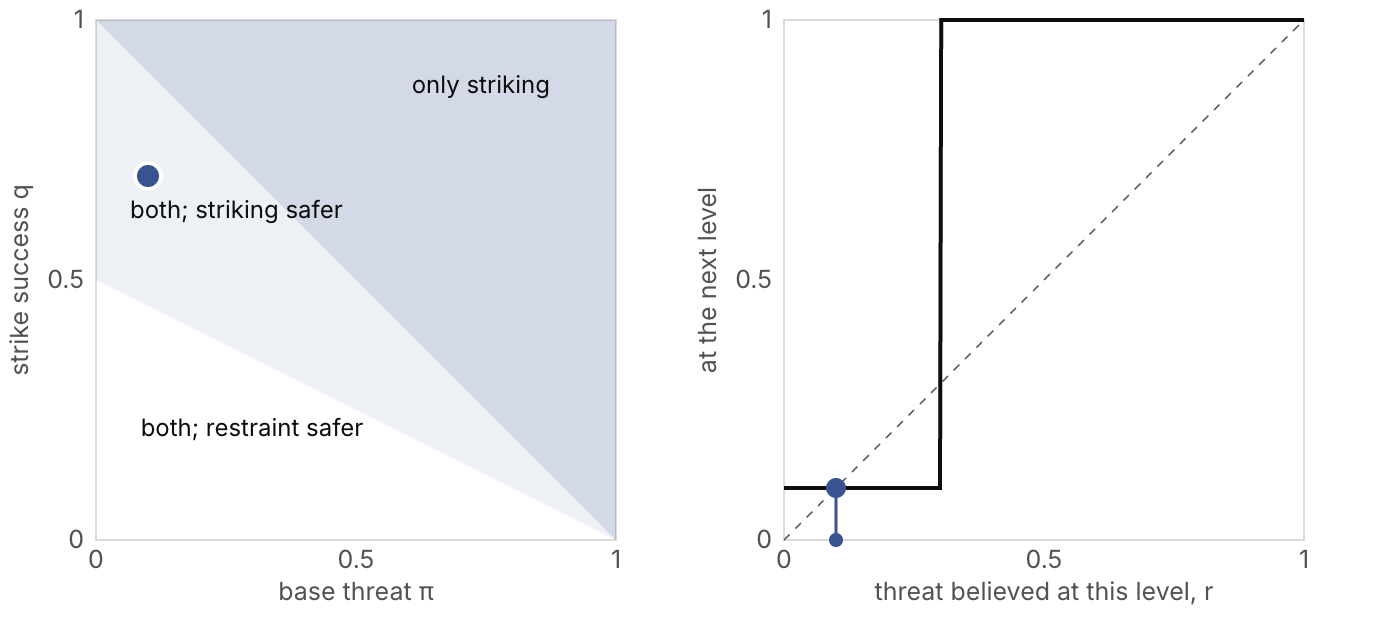 Fig 1: The chain of suspicion and the game after exposure. Left: for identical civilizations, which equilibria exist at each base threat $\pi$ and strike success $q$. Right: the chain $r{n+1} = \pi + (1-\pi)F(r_n)$, with action thresholds spread around $1-q$. A spread of 0.5 around $q = 0.5$ is the original recurrence, which always climbs to 1. Drag the point, or change the spread, to see where the chain stops._
Proposition 4: Before Exposure, Hiding Dominates Revealing
Let the detection probability when civilization $c_i$ chooses to reveal be $\lambda_R$, and when it chooses to hide be $\lambda_H$, with $\lambda_R > \lambda_H$. Let the extinction risk once detected be $\rho_D$, and while undetected $\rho_0$, with $\rho_D > \rho_0$. Let $B_i$ be the cooperation benefits of public exposure and $C_i$ the operational cost of hiding.
$$U_i(\text{reveal}) = -[\lambda_R \rho_D + (1 - \lambda_R) \rho_0] M + B_i$$
$$U_i(\text{hide}) = -[\lambda_H \rho_D + (1 - \lambda_H) \rho_0] M - C_i$$
The difference:
$$U_i(\text{reveal}) - U_i(\text{hide}) = (B_i + C_i) - (\lambda_R - \lambda_H)(\rho_D - \rho_0) M$$
Therefore, hiding is better exactly when
$$(\lambda_R - \lambda_H)(\rho_D - \rho_0) M > B_i + C_i$$
(Lean: prop4_hide_iff).
The condition $\rho_D > \rho_0$ asks little. Even if every non-hostile civilization restrains itself after detection, the hostile share still strikes, so a detected civilization dies with probability at least $\pi q > 0$ (rhoD_pos). For any fixed $B_i$ and $C_i$, a large enough $M$ then makes hiding better (silence_for_large_M). Unlike preemption, silence does not depend on the chain of suspicion or on strikes usually succeeding. It needs only that some hostile civilizations exist and that broadcasting makes detection likelier. Even if broadcasting only slightly raises the probability of being found, the extinction loss makes broadcasting a losing bet.
6. Main Theorem
Definition (Dark Forest State): A system is in the Dark Forest state if for every civilization $c_i \in \mathcal{U}$, both of the following hold simultaneously:
- Actively revealing one’s own location decreases its expected survival rate
- Once mutually located with another civilization, restraint is not a risk-dominant strategy
Theorem (Sufficient Conditions for the Dark Forest): In a civilization system satisfying A1, A2, and B1–B5, with $0 < \pi < 1$ and $0 < q \le 1$:
- Silence (robust): if broadcasting makes detection likelier ($\lambda_R > \lambda_H$) and $M$ is large enough, hiding is better than broadcasting (Proposition 4).
- Preemption (conditional): after mutual detection, mutual striking is an equilibrium once $M > K_i/q^2$ (
threshold_lt_one_iff). It is the only equilibrium when $\pi > r^\ast \approx 1 - q$ (only_striking). It is risk-dominant, and is the one selected when payoffs are observed with small noise, when $q > (1-\pi)/2$. Otherwise mutual restraint is the risk-dominant equilibrium (Proposition 3). - System level: under the replicator dynamics, in which each strategy reproduces in proportion to its fitness, silence spreads from any start whenever hiding is fitter (
silence_spreads). Striking is bistable: it takes over when its initial share exceeds an edge $a^\ast = (r^\ast - \pi)/(1-\pi)$, and dies out below it (striking_takes_over,striking_dies_out). It has the larger basin, $a^\ast < 1/2$, exactly when it is risk-dominant (larger_basin_iff_risk_dominant), and with rare random mutations evolution spends almost all its time in the risk-dominant equilibrium 7. Lean checks this for best-reply dynamics: if every civilization best-replies to last round’s share of strikers and then switches with a small probability, then in a large enough population every stationary distribution puts almost all its weight on striking when striking is risk-dominant, and almost none when restraint is (kmr_stationary,kmr_selects_risk_dominant,kmr_selects_restraint). The same holds when civilizations revise one at a time: the stationary distribution is then unique, and almost all its weight falls on the state in which every civilization plays the risk-dominant action (seq_stationary_unique,seq_selects_risk_dominant,seq_selects_restraint). Section 9 tests the clause in a richer model.
The system is in the Dark Forest state when the first two hold with preemption selected, that is, when $q > (1-\pi)/2$. For identical civilizations with $\lambda_R > \lambda_H$, $\rho_D > \rho_0$ and a strike that costs something, the Dark Forest state holds for every large enough $M$ exactly then (dark_forest_state_iff). When strikes usually fail, the forest is still dark, because everyone hides, but it is no longer a hunting ground.
Proof sketch (backward induction):
- Endgame stage: once civilizations have located each other, the equilibria are those of Proposition 3. Which one is played depends on $\pi$ and $q$, not on how many levels of reasoning a civilization performs.
- Preceding stage: whichever equilibrium is played after detection, $\rho_D \ge \pi q > \rho_0$, so by Proposition 4 hiding dominates revealing for large $M$. One $M$ serves for every such equilibrium (
silence_whatever_follows). - Evolutionary level: this is a claim about dynamics rather than equilibrium. For the replicator dynamics it follows from the theorems in part 3; for richer dynamics, Section 9 checks it. $\square$
On uniqueness: the theorem does not assert a unique equilibrium. Mutual restraint remains an equilibrium whenever $\pi \le 1 - q$, and it is the better one for both sides. When $\pi < r^\ast < 1$ there are exactly three equilibria: none striking, all striking, and a mixed one in which the striking share is the edge $a^\ast$ of part 3 (stag_hunt_equilibria). What the Dark Forest adds is that, when strikes usually succeed, it is not the safe one.
7. Connections to Classical Theory
7.1 Isomorphism with the Hobbesian State of Nature
The Dark Forest Theory is structurally isomorphic to the “state of nature” described by Hobbes in Leviathan 8:
| Hobbesian State of Nature | Dark Forest | Corresponding Condition |
|---|---|---|
| No central authority (no Leviathan) | No universe-level governance body | B1 |
| Everyone seeks self-preservation | Civilizations prioritize survival | A1 |
| Fear of others' intentions | Chain of suspicion | B2 |
| Preemptive strike is rational | Destroy upon discovery | B5 |
The key difference lies in the exit mechanism: Hobbes argued that rational individuals could escape the state of nature by entering a social contract, delegating authority to a sovereign to maintain order. In the Dark Forest, B1 (no supra-sovereign institution), B2 (unverifiable intentions), and B3 (light-speed lag making interaction frequency extremely low) jointly block the path to establishing a social contract. Hobbes’s “state of nature” has an exit; the Dark Forest (under the given conditions) does not.
7.2 Relation to the Fermi Paradox
The Fermi Paradox asks: if many civilizations exist in the universe, why have we observed no evidence of any?
The Dark Forest Theory offers one possible answer: civilizations exist, but silence is the equilibrium strategy. The absence of observable signals is not evidence that civilizations do not exist, but may instead indicate that civilizations are rationally hiding. By the theorem above, this half of the answer is the robust one.
However, this is only one of many candidate explanations for the Fermi Paradox 9. Others, such as the Great Filter 10, the Zoo hypothesis 11 and extremely short civilizational lifespans, can equally account for observational silence without relying on the strong assumptions of the Dark Forest. From the single fact that “we have detected no signals,” it is impossible to determine which explanation is closer to reality.
8. Theoretical Limitations and Critiques
The above derivation is logically self-consistent within its assumption framework. However, each structural condition (B1–B5) can be challenged, and relaxing any one may fundamentally alter the equilibrium structure.
8.1 Fragility of the Unverifiable Intentions Assumption (Relaxing B2)
B2 assumes communication is completely untrustworthy. But game theory offers multiple mechanisms for breaking the cheap talk impasse:
Costly signaling: Conveying intention information by incurring an unforgeable cost (cf. Spence’s education signaling model 12). A civilization could send credible signals through irreversible self-disarmament, resource gifts, or technology disclosure. The key requirement: the cost of faking such signals must be high enough that hostile parties are unwilling to pay it. In a model with two types, benign civilizations signalling and hostile ones not is an equilibrium exactly when the signal costs a benign sender no more than trust is worth and a hostile sender at least as much (Lean: separating_iff). A signal then proves goodwill and silence proves hostility (separating_posterior, separating_silence); if both types signal, the signal again says nothing (pooling_posterior). Whether this is feasible at cosmic scales remains an open question.
Repeated games and reputation: If interactions between civilizations are repeated, the Folk Theorem shows that cooperation can be sustained as an equilibrium among participants with sufficiently high discount factor $\delta$ 2. The Dark Forest indirectly suppresses $\delta$ through B3 (light-speed lag), but if two civilizations are close enough ($\tau_{ij}$ is sufficiently small), repeated-game cooperation remains theoretically viable.
Third-party arbitration and institutions: Adjudication by a super-civilization could partly substitute for credible commitments. B1 rules this out, but B1 is itself an empirical assumption, not a logical necessity. Consensus protocols of the blockchain kind are no way around it, since they need rounds of communication and so run into B3.
8.2 Questionability of the Technological Explosion Assumption (Relaxing B4)
B4 assumes high uncertainty in technological capability growth ($\sigma^2 > 0$). If $\sigma^2$ is constrained to be sufficiently small (i.e., technological development is smooth and predictable), then $\gamma \to 0$: with a random term of mean zero, $\gamma \le \sigma^2/c^2$, where $c$ is the gap, in logarithms, between the lethal level and the capability’s expected path (Lean: explosion_rare). The base threat then lies between $p$ and $p + \gamma$ (basePi_between), so $\pi \to p$, and the room for the chain of suspicion to unravel shrinks with it.
From an empirical standpoint: while human history has seen periods of accelerated technological development, there has never been an instantaneous jump spanning orders of magnitude. Technological development may face physical upper bounds (thermodynamic limits, speed-of-light constraints, computational complexity lower bounds), making infinite explosion physically impossible. On the other hand, this possibility cannot be ruled out either, since we have only one civilization as a sample.
8.3 Strike Costs and Exposure Risk (Relaxing B5)
The model assumes first strikes have a positive net-benefit interval (B5). But at cosmic scales:
- Interstellar strikes require enormous energy investments; $K_i$ may not be negligible relative to $M$.
- The act of striking may itself expose the attacker’s location to third-party civilizations $c_k$ (e.g., through observable energy-release signatures), increasing the attacker’s risk. This means $U_i(A)$ should include an additional penalty term for “exposure to third parties.” A recent paper argues that, once this is counted and no attacker can know it has found everyone, striking whatever one finds stops being an equilibrium whenever a strike is more visible to unseen civilizations than a hider is findable, while hiding remains one 13.
- If defensive technology significantly dominates offensive technology ($q \to 0$), first strikes almost never succeed, and the attack option no longer has positive expected payoff.
8.4 Absolutization of the Survival Axiom (Relaxing A1)
A1 sets survival as the lexicographically highest priority. But civilizations may have more complex value systems:
- They may be willing to accept some survival risk in pursuit of other goals (knowledge, aesthetics, moral principles).
- The “better to kill by mistake” logic driven by extreme risk aversion may itself be considered an unacceptable moral cost.
- If the utility function is not lexicographic but instead admits a finite rate of substitution among objectives, then the extinction loss $M$ is no longer “infinite,” and the model’s extreme conclusions soften significantly.
8.5 Complexity of Multi-Civilization Extensions
The two-player analysis cannot be directly extended to $n$-player games. In a multi-civilization environment:
- Coalition formation may alter the equilibrium structure. If multiple civilizations can form defensive alliances, a single civilization’s first strike faces coalition retaliation, reducing the expected payoff of an attack. Each ally lowers it further (Lean:
uAttackAllied_anti), and with enough allies waiting beats striking whatever the other side does (coalition_deters). - Signal externalities: Even if one civilization is destroyed, the observable signals produced by the attack (energy release, matter ejection) may be detected by third parties, exposing the attacker’s existence and location. This makes the net benefit of the attack strategy lower in multi-civilization environments than the two-player model predicts, and the lower the more third parties there are (
uAttackSeen_anti). - These effects make the optimality of “destroy upon discovery” no longer certain in multi-civilization environments, but the conclusion that “hiding is preferable” is strengthened, since exposure entails facing more potential adversaries. With each other civilization a potential attacker, the risk once detected grows with their number (
rhoN_mono), so if hiding beats revealing among some number of civilizations, it does among more (silence_strengthens).
8.6 The Shape of the Chain of Suspicion
Proposition 2 shows that where the chain of suspicion stops depends on how action thresholds are distributed. The original linear recurrence needs thresholds spread over all of $[0, 1]$, including thresholds near zero: some non-hostile civilizations must be willing to strike at almost no fear. Remove them, and whenever the base threat lies below every civilization’s threshold, the chain stops at $\pi$. If some civilizations can never strike successfully, the chain can also come to rest partway, at a level of fear above $\pi$ but below certainty. In none of these cases does a large extinction loss change the picture, because it moves thresholds only down to $1 - q$.
8.7 What the Proofs Do Not Settle
Lean checks that each theorem follows from its assumptions. It relies on Lean’s kernel, on Mathlib at the pinned commit, and on three standard axioms (propext, Classical.choice, Quot.sound). Some questions are beyond any proof; others are only left out here.
Beyond any proof:
- Whether the model describes the universe. A1, A2 and B1–B5 are assumptions. With one known civilization and no observations of others, there is nothing to check them against, and no proof can supply that.
- Whether a theorem says what the sentence beside it says. Lean checks the formal statement, not its match with the prose. That match is checked only by reading the statements in the attached file, which is worth doing for any claim that matters to you.
- The readings the model builds in. Counting $\gamma$ into the strike probability assumes that a civilization able to destroy another is also willing to (Section 4.2). A1 enters as an additive utility with bounded gains and a large $M$. The global game uses the payoff normalized for large $M$, and lets $q$ range below 0 so that waiting dominates there. Enforcement in Proposition 0 (b) is an added chance of being destroyed, and the repeated game in (d) has abstract payoffs. The models of Sections 8.1 and 8.5 are the simplest that make their points: two types and one signal; strikes, sightings and allies that act independently. In the dynamics with mutations, a population exactly at the tipping share counts as waiting, and when civilizations revise one at a time, a mistake plays the opposite action. A2 never enters the model at all, so its role in the conclusion is an informal reading. Throughout the main argument there are two civilizations. Each of these choices can be argued for or against, not proved.
- Whether B1–B5 are logically independent. Each is shown to be used (
each_condition_used), but whether informal conditions are independent of one another is not a formal question. - The simulation. Section 9 reports twelve runs per setting of two models. In the reasoning one, civilizations apply Propositions 3 and 4, but the world, with one-sided detection, learned beliefs and growth, is not the one the theorems describe, and its settings are ours. Among them are the prior that almost no one strikes, a Beta(0.1, 20); the age of 100 steps at which a civilization counts as established; and the strike cost $K/M = 0.0005$, on which its preemption depends. It illustrates; it cannot prove.
- The analogies of Section 7. The comparisons with Hobbes and with the Fermi paradox are interpretations.
Not proved here, though they could be: the parts of the cited theorems beyond the classes checked above.
- Carlsson and van Damme 4 for two-by-two games in which the state changes how much the other side’s action matters, and for different payoffs on the two sides under priors other than flat. Lean checks every game in which the state shifts a side’s gain by the same amount whatever the other does.
- Kandori, Mailath and Rob 7 for their whole class of dynamics. Lean checks the two standard best-reply dynamics, simultaneous and one at a time; the general class needs the Markov chain tree theorem, which is not yet in Mathlib.
- The folk theorem of Fudenberg and Maskin 2, which sustains any individually rational payoff with minmax punishments. Lean checks Friedman’s version, which sustains any pure profile that pays everyone more than a stage Nash equilibrium.
9. A Simulation
Figure 2 runs two models of a small universe. In the first, behaviours are inherited and culled, which tests the theorem’s system-level clause. In the second, civilizations decide by Propositions 3 and 4, which tests whether the behaviours the theory derives appear when civilizations reason as it says, in a world closer to the novel’s.
Selection. One hundred civilizations live on a torus, each at a random position for its lifetime. Each has two heritable traits: whether it broadcasts, and whether it strikes whatever it detects. A share $p$ is hostile and strikes whatever it detects regardless. A civilization within range can detect another only after light from it has had time to arrive, and then detects it with probability $\lambda_R$ per step if it broadcasts and $\lambda_H \ll \lambda_R$ if it hides. Strikes travel at light speed and succeed with probability $q$. A failed strike reveals the attacker to its target, which strikes back, and any strike exposes the attacker to everyone else with probability $e$. Civilizations also die of other causes, at a low rate. Dead slots are refilled by offspring of the survivors, drawn in proportion to one plus $B$ times their number of peaceful contacts, so contact pays; traits mutate at 2% per birth. Two assumptions are built in: the population stays at one hundred, since every death is followed by a birth, and newcomers copy the strategies of survivors. This is selection acting on strategies, the reading of the replicator dynamics, not an account of how civilizations arise.
Over twelve runs with fixed seeds for each setting, each of 3,000 steps:
- Silence spreads whenever hostile civilizations exist. With the defaults ($p = 0.1$, $q = 0.7$), broadcasting falls from 70% of civilizations to at most 5% in every run, as Proposition 4 predicts.
- Striking spreads only in a hunting ground. With the defaults it dies out, to at most 2% in every run, even though with $\pi = p = 0.1$ the strike success $q = 0.7 > (1-\pi)/2 = 0.45$ makes striking the risk-dominant response after mutual detection. In this universe detection is rarely mutual: striking what you find mostly kills civilizations that had not found you, and the failed strikes and exposures cost the striker more than the rare preempted threat saves. The game played here is therefore not the stag hunt that the replicator theorems describe, which is why the two disagree. Striking survives only when hostile civilizations are common, strikes almost always succeed, and strikes are invisible to others ($p = 0.3$, $q = 0.95$, $e = 0$). There it holds between 15% and 85% of non-hostile civilizations in eleven of twelve runs, and a majority in four.
- Without hostile civilizations, and with enough to gain from contact, the forest stays lit. With $p = 0$ and $B \ge 1$, most civilizations keep broadcasting.
While traits mutate, the state never settles, but its statistics do. Over 30,000 steps with four seeds, the defaults keep broadcasting at 0–1% and striking at 1–3% in every 3,000-step window, while in the hunting ground striking wanders between 17% and 79% from one window to the next. With mutation switched off there are absorbing states, reached within 3,000 steps: broadcasting always dies out, and in the hunting ground striking ends at all or nothing, all in one run of four and nothing in three, the bistability of the replicator theorems.
Reasoning. Here civilizations arise independently, at random places and times, and only where no living civilization’s territory already lies, so the finite universe of A2 sets how many there are. A newcomer is small, and hostile with probability $p$, a type no one else can see (B2). Capability grows on resources shared with overlapping neighbours, territory grows with it, and a larger civilization is easier to find, whether it hides or not. With a small probability per step, capability jumps fivefold (B4). Finding, strikes and exposure work as in the first model, with the same light delays (B3), but a strike succeeds more often the more capable the attacker is relative to its target (B5). Each civilization learns from what it sees: of the civilizations it has found and not struck itself, the share destroyed by a strike within a horizon, starting from the belief that almost no one strikes. It then decides by the post’s formulas: it hides when Proposition 4 says so, and on finding another it strikes when Proposition 3 says so, extended to one-sided detection, unequal capability and exposure. Hostile civilizations strike whatever they find. The figure’s source states the rules in full.
Over twelve runs with fixed seeds for each setting, each of 3,000 steps:
- Silence is learned. Established civilizations, those that have lived 100 steps, mostly hide: a median of 10% broadcast. Those that hide have seen strikes, with a median belief of 0.13 that a found civilization is destroyed, while those still broadcasting are still at their prior of 0.005. With beliefs frozen at the prior, every civilization broadcasts.
- Preemption follows the capability gap. A non-hostile civilization strikes 68% of the civilizations it finds that are at least five times smaller, 60% of those two to five times smaller, 1% of its peers, and none that are larger: a median of 36% of all it finds. Peers wait, as in the first model, because striking an equal risks a return strike. The weak are struck because striking them costs almost nothing: success is nearly certain, and the return strike weak. So preemption does not need hostile civilizations; without any, the median is 37%. It needs strikes that cost the strong little, here $K/M = 0.0005$: at $K/M = 0.05$ it stops, at a median of 1%, which is the $K/(qM)$ term of Proposition 3 doing what it says. Technological explosion doubles it (a median of 18% without), visible strikes cut it (14% at $e = 0.6$), and learning adds to it (14% with beliefs frozen at the prior).
- Newcomers rarely survive. They arrive broadcasting, since their prior says it is safe, and a median of 13% live 100 steps; most are found and struck before they have found anyone. About 20 civilizations are alive at a time.
- Without growth, the forest is quiet and peaceful. With capabilities fixed and equal, a median of 1% of established civilizations broadcast, none strikes first, 87% of newcomers survive, and about 160 civilizations are alive.
This universe settles in the same sense as the first: births and deaths never stop, but over 30,000 steps with four seeds the share of findings that end in a strike stays between 30% and 42% in every 3,000-step window, with about 20 civilizations alive; without growth, about 160, and silent.
The two models agree on silence and differ on preemption. Under selection, striking what one finds rarely pays, because those found rarely know about the finder. With reasoning and growth it pays against the small, and the forest of the novel, in which the grown clear away the young, appears when capabilities differ and strikes are cheap for the strong, whether or not anyone is hostile. Neither model is the world the theorems describe: detection is rarely mutual, beliefs are learned rather than given, and in the second, capability grows. Both leave out coalitions, movement and cosmic scale, and the first also leaves out growth and technological explosion. They illustrate; they are not evidence about the universe.
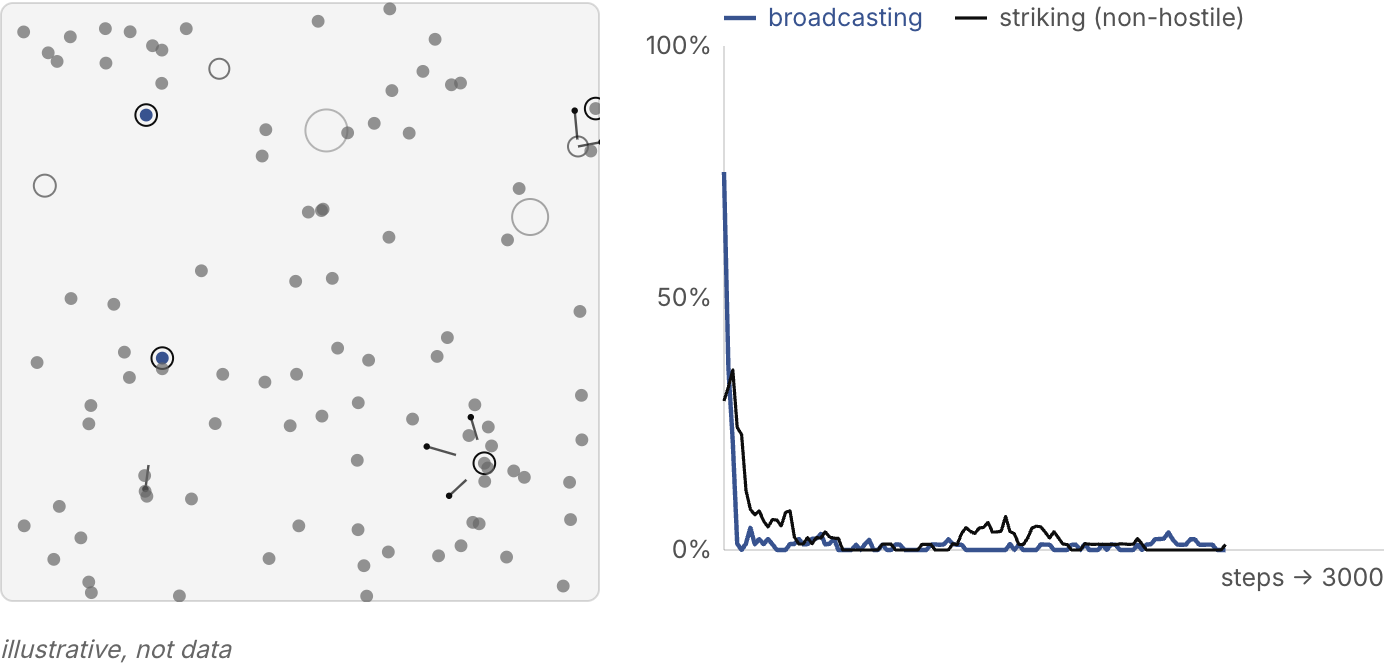 Fig 2: A small dark forest, in two modes. Dots are civilizations: navy ones broadcast, grey ones hide, and a ring marks hostile ones and those that strike (in the reasoning mode, those that have struck first). Faint discs are territories, lines are strikes in flight, and spreading rings are strikes that hit. In the selection mode the chart tracks the share that broadcasts and the share of non-hostile civilizations that strike; in the reasoning mode, the share of established civilizations that broadcast, the share of findings that end in a first strike, and the share of newcomers that live their first 100 steps. The presets set the parameters for the cases in the text; the sliders change them. The numbers are illustrative, not data.
10. Conclusion
Translating the Dark Forest Theory of Three-Body Problem into rigorous game-theoretic form yields a clearer, and more circumscribed, conclusion:
The two axioms “survival priority” and “finite resources” alone are insufficient to derive the Dark Forest. With the structural conditions B1–B5 added, the Dark Forest’s two halves come apart. Silence follows under weak conditions: some hostile civilizations, and a detection advantage for those who hide, are enough given a large extinction loss. Preemption is conditional: after mutual detection, striking and restraint are both equilibria, and striking is the risk-dominant one only when strikes usually succeed, $q > (1-\pi)/2$. The chain of suspicion, in the form the novel gives it, does not by itself carry fear to certainty. Finite resources (A2) never enters the formal model. Read informally, it acts as an amplifier: competition for resources plausibly raises $\gamma$ and with it the base threat, making the forest easier to darken, though nothing above proves this (Section 8.7).
The Dark Forest is a stable equilibrium under specific conditions, but it is not the universe’s only possible fate. It provides sufficient conditions, not inevitability. Relaxing any one of B1–B5 may open a path toward cooperative equilibrium.
Thus, the Dark Forest Theory is less a moral judgment that “all civilizations in the universe are evil” than a cooler structural proposition:
In a universe where extinction cost overrides all else, intentions cannot be credibly verified, and communication delay renders repeated games ineffective, silence is more stable than goodwill.
Note: The formalization in this article is a theoretical reconstruction of the novel’s text, not Liu Cixin’s own formulation. Cosmic sociology as a discipline does not actually exist; its “axioms” can be neither verified nor falsified. The Lean file checks the mathematics of the model, not whether the model describes any real universe.
Revised on September 27, 2026. Proposition 2 previously claimed that the chain of suspicion drives threat to certainty whenever $\pi > 0$, which holds only for uniformly spread thresholds; its note on robustness had the effect of a large $M$ backwards. Section 4.2 derived $\gamma > 0$ from positive variance alone, which does not suffice. Proposition 3’s utilities are now symmetric, Section 1 states when the additive utility represents A1’s order, the main theorem separates silence from preemption, the formal claims, including the counterexamples of Proposition 0, equilibrium selection in the global game for every equilibrium and every smooth prior, long-run selection under the replicator dynamics and under mutations, and the cited theorems of Friedman, of Carlsson and van Damme, and of Kandori, Mailath and Rob for broad classes of games, are checked in Lean, Section 8.7 says what the proofs cannot settle, and Section 9 adds a simulation in two modes, one in which behaviours are selected and one in which civilizations reason by the theory’s own rules.
0. 引言
刘慈欣在《三体》系列中提出的“黑暗森林理论”是一个关于宇宙文明间交互策略的推测性理论。本文从小说给出的公理出发,运用博弈论和决策理论的工具,对该理论做一次形式化的重构1。
论证分为四步:首先说明小说中的两条公理不足以单独推出黑暗森林;然后补上小说所依赖的结构性条件,构建一个不完全信息博弈;接着由此推导黑暗森林的两种行为,即沉默与先发制人,分别在什么条件下是均衡;最后用一个模拟检验理论在演化层面的主张,并讨论结论的局限。文中的形式化结论,都已用 Lean 4 和 Mathlib 做了机器验证,证明文件附在这里:DarkForest.lean。下文每一个经过验证的结论,都注明了对应的定理名;第 8.7 节说明哪些问题是证明无法解决的,哪些被留在了证明之外。第 9 节再用一个更丰富的模型,通过模拟检验演化层面的那一条。同样的证明,连同可以直接构建和检查它们的项目,也放在 github.com/changkun/dark-forest-lean。
先说结论:黑暗森林的两半并不一样结实。沉默在很弱的条件下就成立;而暴露之后的先发制人,只是两个均衡之一,并且只有在打击通常能够成功时,才是更稳妥的那一个。
1. 公理体系
设 $\mathcal{U}$ 为宇宙中所有文明的集合,$|\mathcal{U}| \geq 2$。
公理 A1(生存公理): 小说原文是“生存是文明的第一需要”。对任意文明 $c_i \in \mathcal{U}$ 和任意两个结局 $o, o'$:只要 $c_i$ 在 $o$ 中存续而在 $o'$ 中不存续,无论两者在其他方面有什么差别,$c_i$ 都严格偏好 $o$。记 $S_i(o)$ 为“$c_i$ 在 $o$ 中存续”,则:
$$S_i(o) \wedge \neg S_i(o') ;\Longrightarrow; o \succ_i o'$$
生存是字典序意义上的最高优先级(lexicographic priority)。由于生存只有“存续”和“不存续”两种取值,这个偏好是可以用实值效用函数来表示的(Lean:lex_representable);而实数对上的字典序则根本无法这样表示(lex_real_not_representable)。下面所用的加法形式,即灭绝记为 $-M$、再加上其他收益,只要其他收益有界、并且 $M$ 大于其上界的两倍,就能准确地表示它(additive_lex_of_bounded);如果其他收益可以无限增大,那么任何有限的 $M$ 都做不到(additive_not_lex_of_unbounded)。下面的模型假定收益有界、$M$ 极大。
公理 A2(增长与资源有限): 小说原文是“文明不断增长和扩张,但宇宙中的物质总量保持不变”。设 $R$ 为宇宙总资源量,$r_i(t)$ 为文明 $c_i$ 在时刻 $t$ 占有的资源量。每个文明都倾向于增长,而
$$\sum_{i} r_i(t) \leq R, \quad \forall t$$
所以一个文明的扩张,迟早会压缩其他文明的可用资源。
2. 公理的不充分性
在进入形式化推导之前,有必要先回答一个基本问题:仅凭 A1 和 A2,能否直接推出黑暗森林?
命题 0:仅由 A1 与 A2,不能推出黑暗森林。
证明(反例构造): 设两个文明 $c_1, c_2$ 满足 A1(生存优先)和 A2(资源有限)。考虑以下任一附加条件成立的情形:
(a) 意图可验证: 存在某种机制使 $c_1$ 能够可靠验证 $c_2$ 的善意,且反之亦然。此时双方可以确认对方无敌意,合作成为可支撑的均衡。在第 5 节的模型里,经过验证、为零的打击概率会使等待严格优于打击(Lean:prop0_verified);而一旦不再有敌对的份额,被发现也就不再带来任何风险,于是暴露反而优于隐藏(prop0_verified_reveal)。
(b) 可信契约可执行: 存在可执行的星际协约机制(如由超文明仲裁或某种宇宙级锁定协议),使违约方被惩罚。此时合作可由制度维持。如果这一机制以不低于 $q^2$ 的概率摧毁违约者,那么不论对方怎么做,等待都严格优于打击,因为打击者承担的风险,已经不低于等待所可能承担的最大风险(Lean:prop0_enforced)。
(c) 防御显著优于进攻: 若技术条件使得先发打击几乎无法成功(防御成本远低于进攻成本),则偷袭不具有正的期望收益,安全困境不会激化。在第 5 节的模型里,一次永远不会成功的打击,只要有任何成本,就严格劣于等待(Lean:prop0_no_preemption_when_strikes_fail)。
(d) 通信延迟极小且交互频繁: 若文明间可以高频重复交互,由无名氏定理(Folk Theorem),耐心的参与者可以在重复博弈中维持合作均衡2。Lean 验证了其中最简单的情形:如果对方对任何一次打击的回应,都是在此后每一轮都打击,那么克制是最优回应,当且仅当每一轮的折现因子至少为 $(g-w)/(g-p)$。这里 $w$、$g$、$p$ 分别是双方都克制、打击一个克制的对方、双方都打击时每一轮的收益,$p < w < g$,并且克制时遭到打击的收益不超过 $p$(grim_sustains)。在往返延迟为 $\tau$、折现率为 $r$ 时,这个条件就是 $r\tau \le \log\frac{g-p}{g-w}$(grim_delay),也就是下面条件 B3 所说的那个乘积。同样的结论对任何有限博弈、任何有限数目的参与者都成立:如果一个纯策略组合让每个人都比某个阶段纳什均衡得到更多,那么只要参与者足够有耐心,一有偏离就回到那个均衡,就能把这个组合维持为一个子博弈完美均衡(folk_nash_reversion、folk_subgame_perfect、folk_patient)。这就是 Friedman 的无名氏定理,上面的两行动博弈是它的一个特例(twoAction_folk)。
在上述任一条件下,即使资源有限且生存优先,双方仍可能通过分工、交换、边界划分或威慑均衡维持和平。
因此,A1 与 A2 最多推出“冲突压力存在”或“安全困境可能出现”,但不能推出“必须沉默且发现即摧毁”。$\square$
含义: 黑暗森林不是两条公理的直接逻辑后果。要完成推导,必须补充关于信息结构、通信约束和能力演化的条件。
3. 结构性条件
以下五个条件与 A1、A2 一起,构成推出黑暗森林的一组充分假设。其中两个,是把小说在公理之外给出的两个概念形式化:猜疑链(B2)和技术爆炸(B4)1。每个条件都用得上:单独去掉其中任何一个,都存在某种情形让黑暗森林的某个结论失效,命题 0 的各个情形就是例子(Lean:each_condition_used)。至于这些非形式的条件在逻辑上是否彼此独立,这不是一个形式模型能够回答的问题。
条件 B1(无政府结构): 宇宙中不存在能够执行裁决、惩罚违约、强制和平的超主权机构。形式化地,不存在一个外部执行函数 $E$ 使得任意文明间的协议 $A_{ij}$ 可被可信执行。
条件 B2(意图不可验证): 对于任意两个文明 $c_i, c_j$,$c_i$ 无法可靠地推断 $c_j$ 的真实类型 $\theta_j \in {\text{善意}, \text{恶意}, \text{中性}}$。设 $m_j$ 为 $c_j$ 发出的任何信号,则:
$$P(\theta_j \mid m_j) = P(\theta_j), \quad \forall m_j$$
通信是廉价话语(cheap talk),不携带可验证的意图信息。善意文明和恶意文明可以发出完全相同的信号。
条件 B3(光速迟滞): 信息传播速度有限(不超过光速 $c$)。设文明 $c_i, c_j$ 之间的距离为 $d_{ij}$,则一次往返通信的最小延迟为 $\tau_{ij} \geq 2d_{ij}/c$。这意味着:
- 验证周期极长:任何关于对方当前状态的信息都已经是过时的。
- 重复博弈频率极低:无名氏定理要求足够高的交互频率和足够低的折扣率。当 $\tau_{ij}$ 极大时,有效折扣因子 $\delta \approx e^{-r\tau_{ij}} \to 0$,合作条件难以满足。真正起作用的是乘积 $r\tau_{ij}$:一个眼光足够长远($r$ 很小)的文明,可以部分地逃出这个论证。
- 这是一个物理约束,不取决于文明的意愿或技术水平。
条件 B4(技术爆炸可能): 文明的技术能力可能在远短于通信周期的时间内发生跳跃式增长。设 $x_i(t)$ 为文明 $c_i$ 在时刻 $t$ 的战略能力,其演化满足:
$$x_i(t + \tau) = x_i(t) \cdot e^{g_i \tau + \xi_i}$$
其中 $g_i$ 为基础增长率,$\xi_i$ 为带有正方差 $\sigma^2 > 0$ 的随机项。如果这个随机项可以取任意大的值,比如服从正态分布,那么当前的 $x_j(t) \ll x_i(t)$ 就不构成对 $x_j(t + \tau)$ 的上界:任何一个水平,不论多高,都会以正的概率被达到(Lean:explosion_possible)。单有正方差还不够:一个有界的随机项,不论波动多大,都无法把起点足够低的能力推到那个水平(explosion_needs_reach)。
条件 B5(先手正收益区间): 一旦双方相互定位,先发打击在某些参数条件下能显著提高攻击方的生存概率。设 $q$ 为打击成功的概率,$K_i$ 为打击成本,存在非空的参数区间使得先发打击的期望效用高于克制等待。
4. 形式模型
4.1 效用函数
设灭绝损失为 $M$(取极大值),先发打击成本为 $K_i$,合作/交换等常规收益为 $G_i$。文明 $c_i$ 的效用为:
$$U_i = -M \cdot \mathbf{1}{\text{灭绝}} - K_i \cdot \mathbf{1}{\text{先发打击}} + \varepsilon G_i$$
其中 $M \gg K_i \gg \varepsilon G_i$。这个结构反映了 A1:生存压倒一切,合作收益再大也比不过“别被灭掉”。如上所述,收益有界时,一个大于其上界两倍的有限 $M$ 就能准确表示 A1 的字典序偏好;凡是依赖“$M$ 足够大”的结论,下面的命题都会说明要多大。
4.2 威胁概率
定义以下概率:
- $p$:对方当前为敌对型的先验概率
- $\gamma$:对方当前非敌对,但在验证窗口 $\tau$ 内演化为致命威胁的概率(由 B4 驱动)
- 基础威胁概率:$\pi = 1 - (1-p)(1-\gamma)$
$\pi$ 综合了两类风险:对方现在就危险,或对方现在不危险但很快会变得危险。由 B4,只要随机项可以任意大,就有 $\gamma > 0$(explosion_possible);由 B2(意图不可验证),$p$ 无法被更新为 0。因此 $\pi > 0$(Lean:basePi_pos),即使眼下没有任何文明是敌对的。
在暴露之后的博弈里,要紧的是对方无论如何都会打击的概率,我们就用 $\pi$ 表示它。把 $\gamma$ 算进这个概率,等于假定一个有能力毁灭别人的文明,也就有了这个意愿。这是我们对 B4 的一种解读,而不是 B4 本身推得出来的。
5. 核心推导
命题 1:和平声明无法构成可信承诺
由 B2,信号不携带可验证信息。任何“我没有恶意”的声明都是廉价话语:善意文明与恶意文明都能发出完全相同的信号。
因此,对任意和平声明 $m$,都有 $P(\text{对方是威胁} \mid m) = \pi$(Lean:prop1_posterior_is_prior),只要 $0 < \pi < 1$(prop1_cheap_talk):
$$0 < P(\text{对方是威胁} \mid m) < 1$$
通信不能消除恐惧。不是因为没有人会表达善意,而是因为恶意方也会表达善意。
命题 2:只有当恐惧超过打击的门槛时,猜疑链才会崩塌
在 B2 和 B3 的约束下,$c_i$ 面临的不仅是“对方是否危险”的一阶不确定性,还有递归的高阶不确定性:
- 第 0 阶:对方可能是威胁,概率为 $\pi$
- 第 1 阶:即使对方不是基础威胁,它可能因为担心我而先发制人
- 第 2 阶:即使对方不担心我,它可能担心我担心它……
一个诱人的捷径,是把“因恐惧而先打”的概率直接等同于当前的威胁估计 $r_n$,得到递推
$$r_0 = \pi, \qquad r_{n+1} = \pi + (1 - \pi) r_n$$
它的解是 $r_n = 1 - (1-\pi)^{n+1}$,对任何 $\pi > 0$ 都趋于 1(Lean:linearChain_closed、linearChain_tendsto_one)。代数没有错,但结论其实是这条捷径带进来的。记 $F(r)$ 为:当相信对方以概率 $r$ 打击时,会选择打击的非敌对文明所占的比例;$F$ 就是这些文明行动门槛的分布函数。猜疑链于是写成
$$r_0 = \pi, \qquad r_{n+1} = \pi + (1 - \pi) F(r_n)$$
那条捷径,就是 $F(r) = r$ 的特例,也就是行动门槛在 $[0, 1]$ 上均匀分布(linear_is_uniform)。A1、A2 和 B1–B5 里,没有哪一条说门槛是这样分布的。下面的命题 3 会说明门槛是什么:当 $r$ 超过 $r^\ast \approx 1 - q$ 时,文明就会打击。如果各个文明彼此相同,$F$ 就是在 $r^\ast$ 处的一个阶跃,猜疑链要么当场停住,要么当场崩塌:
- 若 $\pi \le r^\ast$,则对所有 $n$ 都有 $r_n = \pi$:本来不是威胁的文明,永远不会出手(
chain_stops); - 若 $\pi > r^\ast$,则从第一步起 $r_n = 1$(
chain_unravels)。
一般地,猜疑链不会越过任何一个“停靠点”:只要 $\bar r \ge \pi$ 且 $\pi + (1-\pi)F(\bar r) \le \bar r$,它就永远不超过 $\bar r$(chain_le_resting_point);所以只有当 1 以下没有任何停靠点时,它才会走到确定无疑(chain_below_one_of_resting_point)。可见,猜疑链本身并不会把恐惧推到必然。只有当基础威胁已经超过打击的门槛,或者门槛的分布让停靠点荡然无存时,它才会这样。图 1 可以调整 $\pi$、典型的打击成功率 $q$ 以及门槛的分散程度,看猜疑链停在哪里。
命题 3:暴露之后,打击与克制都是均衡
一旦双方相互定位,文明 $c_i$ 要在先发打击和等待之间选择。设打击成功的概率为 $q$,双方相同;设对方打击的概率为 $r$。被打击时,以概率 $q$ 被消灭;一次失败的打击会暴露攻击者,目标的回击以概率 $q$ 将其消灭。等待($W$)与打击($A$)的期望效用为:
$$U_i(W) = -r q M, \qquad U_i(A) = -(1 - q) q M - K_i$$
当 $q > 0$ 时,先发打击优于等待,当且仅当
$$r > r^\ast = 1 - q + \frac{K_i}{qM}$$
(Lean:prop3_threshold)。$M$ 越大,这个门槛越低,但只会降到 $1 - q$ 为止(threshold_tendsto)。巨大的灭绝损失会让文明在恐惧超过 $1 - q$ 时出手,却不会让它在任何一点恐惧下都出手。
所以,暴露之后的博弈是一场猎鹿博弈(stag hunt)。设比例为 $\pi$ 的文明无论如何都会打击,非敌对文明以概率 $a$ 打击,于是对方打击的概率是 $\pi + (1-\pi)a$:
- 只要 $r^\ast < 1$,相互打击($a = 1$)就是一个均衡(
strike_equilibrium_iff),也就是只要 $K_i < q^2 M$(threshold_lt_one_iff)。 - 相互克制($a = 0$)是均衡,当且仅当 $\pi \le r^\ast$(
wait_equilibrium_iff),这正是猜疑链停住的条件。 - 打击是风险占优(risk-dominant)的3,也就是面对“两种可能各占一半”时的更好回应,当且仅当 $r^\ast < (1+\pi)/2$(
strike_risk_dominant_iff);$M$ 很大时,这个条件就是 $q > (1-\pi)/2$(strike_risk_dominant_iff_q)。
克制对双方都是更好的均衡,因为两边都能活下来;而当打击通常能成功时,打击是更稳妥的押注。如果双方观察收益时都带一点噪声,这类二乘二博弈的参与者会协调到风险占优的均衡上4。Lean 针对这里的博弈做了验证。设每个文明只能看到 $q$ 的一个带噪声的信号,也就是 $q$ 加上一个均值为零、独立抽取、没有原子的噪声,并先看教科书里的情形:$q$ 的先验是平坦的。这时在每一个均衡里,不论对称与否,双方都在信号超过 $(1-\pi)/2$ 时打击、低于它时等待,而这正是风险占优的边界;这个门槛策略本身也确实是一个均衡(global_game_pair、global_game_unique、threshold_is_equilibrium、selected_is_risk_dominant)。噪声只通过一个性质起作用:一个信号恰好落在门槛上的文明,会认为对方信号更高的可能性是一半,因为两个独立同分布、不会相等的噪声,谁大谁小的可能性相同(noise_half、flatNoise)。整条实数轴上的平坦先验并不是真正的概率分布,所以 Lean 还处理了区间上的均匀先验,并且在那里把信念推导出来,而不是直接假设:信号只要离区间两端足够远,就不含任何关于噪声的信息,于是对对方信号的信念和 $q$ 的期望值,都恰好和平坦先验下的一样(interior_signal、belief_is_conditional、posterior_mean)。对绝对值不超过 $\sigma$ 的这类噪声,只要先验的范围伸进两个占优区域各至少 $2\sigma$,均衡选择就在每一个噪声水平上都成立,而不只是在极限里成立(uniform_prior_selects);占优区域指的是某个行动不论对方怎么做都更好的区域,在按大 $M$ 归一化的收益里,就是 $q < 0$ 和 $q > 1-\pi$。对其他先验,Lean 证明了一个界:如果信念与均匀先验下的信念相差不超过 $\eta$,那么每一个均衡的切换点都落在 $(1-\pi)/2$ 两侧 $(2-\pi)\eta$ 以内(global_game)。如果先验的范围伸进两个占优区域,并且其密度在这个范围内不低于 $m$、每单位 $q$ 的变化不超过 $L$,那么由贝叶斯法则,信念与均匀先验下的信念相差不超过 $\eta = \max(\sigma, 2L\sigma/(m-L\sigma))$(conditional_of_density、smooth_prior_selects)。于是不论噪声服从什么分布,这条带都会随噪声变小而收拢到 $(1-\pi)/2$(smooth_prior_limit)。这正是 Carlsson 和 van Damme 的论证中,这里的博弈所需要的那一步。在上述每一种先验下,不论先验边缘处的信念如何,均衡都存在(equilibrium_exists),所以这些结论说的都不是一个空集。Lean 还在这个博弈之外证明了这一结果,适用于每一个这样的二乘二协调博弈:状态对一方行动的收益,不论对方怎么做,都平移同样多。在平坦先验下,双方收益相同时,每一个均衡都恰好在风险占优的边界处切换,而且在每一个噪声水平上都是如此(cvd_symmetric、cvd_risk_dominant)。双方收益不同、噪声不超过 $\sigma$ 时,两边都在距某一点 $2\sigma$ 以内切换,噪声消失时恰好在那一点切换;在那一点,双方无差异时所需的概率之和为一(这里要求这一点不落在任何一方的占优区域里)(cvd_asymmetric_flat、cvd_asymmetric_limit)。那一点正是 Harsanyi 和 Selten 为非对称博弈给出的风险占优边界(cvd_theta_is_risk_dominance)。所以,黑暗森林在暴露之后的逻辑仍然成立,但理由比“猜疑链无限放大”要窄:当 $q > (1-\pi)/2$ 时,面对不知道对方会怎么做,先发制人是更稳妥的回答。当打击通常会失败时,克制才是。
Schelling 把背后的机制称为“对突然袭击的相互恐惧”5;关于安全困境的研究,长期以来讨论的就是它的严重程度如何取决于进攻和防御哪一方占优6。在这里,这个优势就是 $q$。
图 1:猜疑链与暴露之后的博弈。左:对彼此相同的文明,在每个基础威胁 $\pi$ 和打击成功率 $q$ 下,存在哪些均衡。右:猜疑链 $r{n+1} = \pi + (1-\pi)F(r_n)$,行动门槛分布在 $1-q$ 附近。以 $q = 0.5$ 为中心、分散程度为 0.5 时,就是原来那条递推,它总会爬到 1。拖动左边的点,或改变分散程度,看猜疑链停在哪里。_
命题 4:暴露前,隐藏优于公开
设文明 $c_i$ 选择公开暴露时被发现的概率为 $\lambda_R$,选择隐藏时为 $\lambda_H$,且 $\lambda_R > \lambda_H$。设被发现后的灭绝风险为 $\rho_D$,未被发现时为 $\rho_0$,且 $\rho_D > \rho_0$。设公开暴露带来的合作收益为 $B_i$,隐藏的运营成本为 $C_i$。
$$U_i(\text{暴露}) = -[\lambda_R \rho_D + (1 - \lambda_R) \rho_0] M + B_i$$
$$U_i(\text{隐藏}) = -[\lambda_H \rho_D + (1 - \lambda_H) \rho_0] M - C_i$$
两者之差:
$$U_i(\text{暴露}) - U_i(\text{隐藏}) = (B_i + C_i) - (\lambda_R - \lambda_H)(\rho_D - \rho_0) M$$
因此,隐藏更好,当且仅当
$$(\lambda_R - \lambda_H)(\rho_D - \rho_0) M > B_i + C_i$$
(Lean:prop4_hide_iff)。
$\rho_D > \rho_0$ 这个条件要求很低。即使所有非敌对文明在发现对方之后都克制自己,敌对的那一部分仍然会打击,所以一个被发现的文明,至少会以 $\pi q > 0$ 的概率被消灭(rhoD_pos)。对任何固定的 $B_i$ 和 $C_i$,只要 $M$ 足够大,隐藏就更好(silence_for_large_M)。和先发制人不同,沉默不依赖猜疑链,也不依赖打击通常能成功。它只需要存在一些敌对文明,并且广播会让自己更容易被发现。哪怕公开广播只略微提高了被发现的概率,灭绝代价也足以让广播成为一笔亏本的赌注。
6. 主定理
定义(黑暗森林态): 若对任意文明 $c_i \in \mathcal{U}$,同时满足:
- 主动暴露自身位置会降低其期望生存率
- 一旦与其他文明相互定位,克制等待不是风险占优策略
则称该系统处于黑暗森林态。
定理(黑暗森林的充分条件): 在满足 A1、A2 与 B1–B5 的文明系统中,设 $0 < \pi < 1$,$0 < q \le 1$:
- 沉默(稳健): 若广播使自己更容易被发现($\lambda_R > \lambda_H$),且 $M$ 足够大,则隐藏优于广播(命题 4)。
- 先发制人(有条件): 相互定位之后,只要 $M > K_i/q^2$,相互打击就是一个均衡(
threshold_lt_one_iff)。当 $\pi > r^\ast \approx 1 - q$ 时,它是唯一的均衡(only_striking)。当 $q > (1-\pi)/2$ 时,它是风险占优的,也是收益带有微小噪声时会被选中的那个均衡;否则,相互克制才是风险占优的均衡(命题 3)。 - 系统层面: 在复制者动态(replicator dynamics)下,也就是每种策略按照自身的适应度繁衍时,只要隐藏的适应度更高,沉默就会从任何起点蔓延开来(
silence_spreads)。打击则是双稳态的:它的初始比例超过边界 $a^\ast = (r^\ast - \pi)/(1-\pi)$ 时,打击会占据全体;低于这个边界时,打击会消亡(striking_takes_over、striking_dies_out)。打击拥有更大的吸引域,即 $a^\ast < 1/2$,当且仅当它是风险占优的(larger_basin_iff_risk_dominant);而在罕见的随机突变之下,演化几乎所有的时间都停留在风险占优的均衡上7。Lean 针对最优回应动态验证了这一点:如果每个文明都对上一轮的打击比例做出最优回应,然后以一个很小的概率改变行动,那么只要种群足够大,在每一个平稳分布里,打击是风险占优时,几乎全部权重都落在打击上;克制是风险占优时,几乎没有权重落在打击上(kmr_stationary、kmr_selects_risk_dominant、kmr_selects_restraint)。文明一次只有一个调整时也是如此:这时平稳分布是唯一的,几乎全部权重都落在每个文明都采取风险占优行动的那个状态上(seq_stationary_unique、seq_selects_risk_dominant、seq_selects_restraint)。第 9 节在一个更丰富的模型里检验这一条。
当前两条成立、并且选中的是先发制人,也就是 $q > (1-\pi)/2$ 时,系统处于黑暗森林态。对于相同的文明,只要 $\lambda_R > \lambda_H$、$\rho_D > \rho_0$,并且打击有成本,黑暗森林态对所有足够大的 $M$ 成立,当且仅当 $q > (1-\pi)/2$(dark_forest_state_iff)。当打击通常会失败时,森林依然是黑的,因为人人都在隐藏,但它已经不再是猎场。
证明思路(逆向归纳):
- 终局阶段:相互定位之后,均衡就是命题 3 所说的那些。选中哪一个,取决于 $\pi$ 和 $q$,而不取决于一个文明推理了多少阶。
- 前一阶段:无论被发现之后玩的是哪个均衡,都有 $\rho_D \ge \pi q > \rho_0$,于是由命题 4,$M$ 足够大时隐藏优于公开。同一个 $M$ 对所有这样的均衡都适用(
silence_whatever_follows)。 - 演化层面:这是一个关于动态的主张,不是关于均衡的。在复制者动态下,它由第 3 条里的那些定理给出;对于更丰富的动态,由第 9 节来检验。$\square$
关于唯一性: 本定理并不断言均衡唯一。只要 $\pi \le 1 - q$,相互克制就始终是一个均衡,而且对双方都是更好的那个。当 $\pi < r^\ast < 1$ 时,均衡恰好有三个:都不打击、都打击,以及一个混合均衡,其中打击的份额正是第 3 条里的边界 $a^\ast$(stag_hunt_equilibria)。黑暗森林补充的是:当打击通常能成功时,它不是那个稳妥的均衡。
7. 与经典理论的关联
7.1 与霍布斯自然状态的同构
黑暗森林理论在结构上与霍布斯在《利维坦》中描述的“自然状态”(state of nature)同构8:
| 霍布斯自然状态 | 黑暗森林 | 对应条件 |
|---|---|---|
| 无中央权威(无利维坦) | 无宇宙级治理机构 | B1 |
| 人人自保 | 文明以生存为第一需要 | A1 |
| 对他人意图的恐惧 | 猜疑链 | B2 |
| 先发制人是理性选择 | 发现即摧毁 | B5 |
关键区别在于退出机制:霍布斯认为理性个体可以通过社会契约(social contract)委托主权者维持秩序,从而逃离自然状态。在黑暗森林中,B1(无超主权机构)、B2(意图不可验证)和 B3(光速迟滞使交互频率极低)共同阻断了社会契约的建立路径。霍布斯的“自然状态”有出口,黑暗森林(在给定条件下)没有。
7.2 与费米悖论的关系
费米悖论问:如果宇宙中存在大量文明,为什么我们没有观察到任何迹象?
黑暗森林理论提供了一个可能的回答:文明存在,但沉默是均衡策略。可观测信号的缺失不是文明不存在的证据,而可能是文明在理性地隐藏自己。按照上面的定理,这一半回答恰恰是比较结实的那一半。
但需指出,这只是费米悖论的众多候选解释之一9。其他解释,如大过滤器假说10、动物园假说11、文明寿命极短等,同样能解释观测上的沉默,且不依赖黑暗森林的强假设。仅从“我们没观测到信号”这一事实,无法判断哪种解释更接近真实。
8. 理论局限性与批判
上述推导在其假设框架内是逻辑自洽的。但每一条结构性条件(B1–B5)都可以被质疑,且放松任一条件都可能从根本上改变均衡结构。
8.1 意图不可验证假设的脆弱性(B2 的松弛)
B2 假设通信完全不可信。但博弈论中存在多种打破廉价话语困境的机制:
代价信号(costly signaling): 通过付出不可伪造的成本来传递意图信息(如 Spence 的教育信号模型12)。文明可以通过不可逆的自我裁军、资源赠与或技术公开来发送可信信号。关键在于:这类信号的伪造成本必须高到恶意方不愿支付。在一个只有两类文明的模型里,善意的文明发信号、敌对的文明不发,是一个均衡,当且仅当信号对善意发送者的成本不超过被信任的价值,而对敌对发送者的成本不低于这个价值(Lean:separating_iff)。这时,信号证明了善意,沉默证明了敌意(separating_posterior、separating_silence);如果两类文明都发信号,信号就又什么也说明不了(pooling_posterior)。在宇宙尺度上这是否可行,是一个开放问题。
重复博弈与声誉: 如果文明间的交互是重复的,无名氏定理表明合作可以在折扣因子 $\delta$ 足够大的参与者之间作为均衡被维持2。黑暗森林通过 B3(光速迟滞)间接压低了 $\delta$,但如果两个文明距离足够近($\tau_{ij}$ 足够小),重复博弈合作仍然理论上可行。
第三方仲裁与制度: 由超文明来裁决,可以部分替代可信承诺。B1 排除了这种可能,但 B1 本身是一个经验假设,不是逻辑必然。至于区块链式的共识协议,它需要多轮通信,同样会撞上 B3,绕不过去。
8.2 技术爆炸假设的可疑性(B4 的松弛)
B4 假设技术能力增长具有高不确定性($\sigma^2 > 0$)。如果 $\sigma^2$ 被约束得足够小(技术发展平稳可预测),则 $\gamma \to 0$:对均值为零的随机项,$\gamma \le \sigma^2/c^2$,其中 $c$ 是致命水平与能力预期路径之间的差距(取对数后)(Lean:explosion_rare)。这时基础威胁介于 $p$ 与 $p + \gamma$ 之间(basePi_between),于是 $\pi \to p$,猜疑链崩塌的余地也随之变小。
从经验角度看:人类历史中的技术发展虽有加速期,但从未出现过跨数量级的瞬间跳跃。技术发展可能存在物理上限(热力学极限、光速约束、计算复杂性下界),使得无限爆炸在物理上不可能。但反过来也无法排除这种可能性,因为我们只有一个文明的样本。
8.3 打击成本与暴露风险(B5 的松弛)
模型假设先发打击有正的净收益区间(B5)。但在宇宙尺度上:
- 跨星际打击需要巨大能量投入,$K_i$ 可能不是相对于 $M$ 可忽略的。
- 打击行为本身可能暴露攻击者的位置于第三方文明 $c_k$(例如通过能量释放的可观测信号),增大攻击者的风险。这意味着 $U_i(A)$ 应包含一个“暴露于第三方”的额外惩罚项。最近有一篇论文认为,把这一项算进去,并且承认攻击者永远无法确知自己已经找到了所有人之后,只要一次打击对未被发现的文明来说,比一个隐藏者更容易被看见,“见一个打一个”就不再是均衡,而“人人隐藏”仍然是13。
- 如果防御技术显著强于进攻技术($q \to 0$),先发打击几乎不可能成功,打击不再具有正的期望收益。
8.4 生存公理的绝对化(A1 的松弛)
A1 将生存设为字典序最高优先级。但文明可能有更复杂的价值体系:
- 愿意承担一定生存风险来追求其他目标(知识、美学、道德准则)。
- 极端风险规避导致的“宁可误杀”逻辑,本身可能被视为不可接受的道德代价。
- 如果效用函数不是字典序的,而是各目标间存在有限的替代率(finite rate of substitution),则灭绝损失 $M$ 不再是“无穷大”,模型的极端结论会显著软化。
8.5 多文明扩展的复杂性
二人博弈的分析不能直接推广到 $n$ 人博弈。在多文明环境中:
- 联盟形成(coalition formation) 可能改变均衡结构。如果多个文明能够形成防御联盟,则单个文明的先发打击面临联盟报复,打击的期望收益下降。每多一个盟友,它就再低一些(Lean:
uAttackAllied_anti);盟友足够多时,不论对方怎么做,等待都优于打击(coalition_deters)。 - 信号外部性: 即使消灭了一个文明,攻击行为产生的可观测信号(能量释放、物质抛射)可能被第三方探测到,暴露攻击者的存在和位置。这使得打击策略在多文明环境中的净收益比二人博弈模型预测的更低,而且第三方越多就越低(
uAttackSeen_anti)。 - 这些效应使得“发现即摧毁”在多文明环境下的最优性不再确定,但“倾向隐藏”的结论反而被强化了,因为暴露后面临的潜在敌手更多。每一个其他文明都是潜在的攻击者,所以被发现之后的风险随文明的数目增长(
rhoN_mono);如果在某个数目的文明之中隐藏优于公开,那么文明更多时也是如此(silence_strengthens)。
8.6 猜疑链的形状
命题 2 说明,猜疑链停在哪里,取决于行动门槛如何分布。原来那条线性递推,需要门槛铺满整个 $[0, 1]$,包括接近零的门槛:总得有一些非敌对文明,在几乎毫无恐惧时也愿意出手。把这些文明去掉,只要基础威胁低于所有文明的门槛,猜疑链就停在 $\pi$。如果有些文明的打击永远不可能成功,猜疑链还可能停在半路,停在一个高于 $\pi$、却低于确定无疑的恐惧水平上。无论哪种情形,巨大的灭绝损失都改变不了这幅图景,因为它只能把门槛压到 $1 - q$。
8.7 证明无法解决的问题
Lean 检查的是每个定理都能从它的前提推出。它所依赖的是 Lean 的内核、固定版本的 Mathlib,以及三条标准公理(propext、Classical.choice、Quot.sound)。有些问题是任何证明都无法解决的;另一些只是这里没有证明。
任何证明都无法解决的:
- 这个模型是否描述了宇宙。 A1、A2 和 B1–B5 都是假设。我们只知道一个文明,也观察不到其他文明,没有任何东西可以拿来检验它们,而证明提供不了这样的东西。
- 一个定理说的,是否就是它旁边那句话说的。 Lean 检查的是形式化的命题,而不是它与文字是否相符。这种相符只能靠阅读附带文件里的命题来检查;对你在意的结论,值得亲自读一读。
- 模型里内置的解读。 把 $\gamma$ 算进打击概率,假设了一个有能力摧毁对方的文明也有意愿这样做(第 4.2 节)。A1 以加法效用的形式进入模型,并要求其他收益有界、$M$ 很大。全局博弈用的是按大 $M$ 归一化的收益,并允许 $q$ 取负值,好让等待在那里占优。命题 0 (b) 中的执行机制,被表示为额外的一份被摧毁的概率;(d) 中的重复博弈,用的是抽象的收益。第 8.1 节和第 8.5 节的模型,是足以说明问题的最简单的模型:两类文明和一种信号;打击、目击和盟友都彼此独立地起作用。在带突变的动态里,恰好处在临界比例上的种群算作等待;而在一次只有一个文明调整的动态里,一次失误就是采取相反的行动。A2 根本没有进入模型,所以它在结论中的作用只是一种非形式的解读。主论证里自始至终只有两个文明。这些选择都可以辩护或反驳,但无法证明。
- B1–B5 在逻辑上是否彼此独立。 已经证明每个条件都用得上(
each_condition_used),但非形式的条件是否彼此独立,不是一个形式问题。 - 模拟。 第 9 节报告的是两种模型在每种设定下十二次运行的结果。在推理模型里,文明运用命题 3 和命题 4,但那个世界,有单方面的发现、学来的信念和增长,并不是定理所描述的世界,而且它的设定是我们选的。其中包括:几乎没有谁会打击的先验,即 Beta(0.1, 20);一个文明算作已成形的年龄,100 步;以及打击成本 $K/M = 0.0005$,先发打击的结果依赖于它。它只能说明,不能证明。
- 第 7 节的类比。 与霍布斯和费米悖论的比较,都是解读。
这里没有证明、但原则上可以证明的: 所引用的定理中,超出上面已验证的那些博弈类的部分。
- Carlsson 和 van Damme 的定理4,用于状态会改变对方行动影响大小的二乘二博弈,以及在平坦先验之外、双方收益不同的情形。Lean 验证的是:状态对一方的收益,不论对方怎么做,都平移同样多的每一个博弈。
- Kandori、Mailath 和 Rob 的定理7,用于他们那一整类动态。Lean 验证的是两种标准的最优回应动态:同时调整,以及一次一个;一般的那一类需要马尔可夫链树定理,而 Mathlib 里还没有它。
- Fudenberg 和 Maskin 的无名氏定理2,它借助极小极大惩罚,可以维持任何个体理性的收益。Lean 验证的是 Friedman 的版本:任何一个让每个人都比某个阶段纳什均衡得到更多的纯策略组合,都可以维持。
9. 一个模拟
图 2 运行的是一个小宇宙的两种模型。在第一种里,行为可以遗传,并被淘汰,它检验的是定理在系统层面的那一条。在第二种里,文明按照命题 3 和命题 4 做决定,它检验的是:当文明像理论所说的那样推理时,在一个更接近小说的世界里,理论推出的那些行为会不会出现。
选择。 一百个文明生活在一个环面(torus)上,每个文明在一生之中都待在一个随机的位置上。每个文明有两个可遗传的性状:是否广播,以及是否打击自己发现的一切。比例为 $p$ 的文明是敌对的,不管性状如何,发现什么就打击什么。一个文明只有在另一个文明的光有时间抵达之后,才可能发现它;此后,对方若在广播,每一步被发现的概率是 $\lambda_R$,若在隐藏,则是远小于它的 $\lambda_H$。打击以光速飞行,成功的概率是 $q$。失败的打击会把攻击者暴露给目标,目标随即回击;任何一次打击,都会以概率 $e$ 把攻击者暴露给其他所有文明。文明也会以很低的概率死于别的原因。空出来的位置,由幸存者的后代填补,选中某个幸存者的机会,与“一加上 $B$ 乘以它的和平接触数”成正比,所以接触是有好处的;每次出生,性状有 2% 的概率突变。这里内置了两个假设:每一次死亡之后都跟着一次出生,所以总数始终是一百;新文明照搬幸存者的策略。这是作用在策略上的选择,也就是复制者动态的读法,而不是在讲文明如何诞生。
每种设定用固定的随机种子各跑十二次,每次 3,000 步:
- 只要存在敌对文明,沉默就会蔓延。 在默认参数下($p = 0.1$,$q = 0.7$),每一次运行中,广播的文明都从 70% 降到了 5% 以下,正如命题 4 所预言的。
- 只有在猎场里,打击才会蔓延。 在默认参数下,打击这个性状会消亡,每次都降到 2% 以下,尽管在 $\pi = p = 0.1$ 时,打击成功率 $q = 0.7 > (1-\pi)/2 = 0.45$ 意味着在相互定位之后,打击是风险占优的回应。在这个宇宙里,定位很少是相互的:见什么打什么,杀掉的大多是还没发现自己的文明,而失败的打击和暴露给攻击者带来的代价,超过了偶尔先下手除掉一个威胁所省下的。所以,这里玩的并不是复制者定理所描述的那场猎鹿博弈,这正是两者结论不同的原因。只有当敌对文明很多、打击几乎必定成功、并且打击不会被别人看见时($p = 0.3$,$q = 0.95$,$e = 0$),打击才能存活下来:十二次运行里有十一次,它占到非敌对文明的 15% 到 85%,其中四次过半。
- 没有敌对文明、而接触又足够有利时,森林会一直亮着。 当 $p = 0$、$B \ge 1$ 时,大多数文明会一直广播下去。
只要性状还会突变,状态就永远不会停下来,但它的统计会稳定下来。用四个种子各跑 30,000 步,在默认参数下,每个 3,000 步的窗口里,广播都保持在 0–1%,打击保持在 1–3%;而在猎场里,打击在相邻的窗口之间游荡于 17% 和 79% 之间。关掉突变,就出现了吸收态,而且在 3,000 步以内就会到达:广播总会消失;在猎场里,打击最后要么全有、要么全无,四次运行里一次全有、三次全无,这正是复制者定理所说的双稳态。
推理。 在这里,文明在随机的时间、随机的地点各自独立地诞生,而且只在没有任何活着的文明占据的地方诞生,所以 A2 所说的有限宇宙决定了文明的数目。新文明很小,以概率 $p$ 是敌对的,而这种类型别人看不见(B2)。能力依靠与相邻文明共享的资源增长,领地随之扩大;越大的文明越容易被发现,不管它隐藏与否。每一步都有一个很小的概率,让能力一下子增长到五倍(B4)。发现、打击和暴露的规则与第一种模型相同,光的延迟也相同(B3),只是攻击者相对于目标的能力越强,打击就越容易成功(B5)。每个文明都从自己看到的东西中学习:在它发现、而不是由它自己打击的那些文明中,有多大比例在一段时间之内被打击摧毁;起初,它相信几乎没有谁会打击。然后,它按本文的公式做决定:命题 4 说该隐藏时就隐藏;发现另一个文明时,命题 3 说该打击时就打击,这里把命题 3 推广到了单方面发现、能力不等以及暴露的情形。敌对文明发现什么就打击什么。完整的规则写在这张图的源代码里。
每种设定用固定的随机种子各跑十二次,每次 3,000 步:
- 沉默是学来的。 已成形的文明,也就是活过了 100 步的文明,大多在隐藏:广播的比例中位数是 10%。隐藏的那些都见过打击,它们认为一个被发现的文明会被摧毁的信念,中位数是 0.13;还在广播的那些,信念仍停留在 0.005 的先验上。把信念冻结在先验上,所有文明都会广播。
- 先发打击跟着能力差距走。 一个非敌对文明,对自己发现的、比自己小五倍以上的文明,有 68% 会打击;对小二到五倍的,有 60%;对势均力敌的,只有 1%;对比自己大的,一个也不打击。在它发现的全部文明中,打击的比例中位数是 36%。势均力敌的双方会等待,这与第一种模型相同,因为打击一个同等的对手,要冒遭到回击的风险。弱者会被打击,是因为打击它们几乎没有代价:成功几乎是必然的,回击也很弱。所以,先发打击并不需要敌对文明;没有任何敌对文明时,中位数是 37%。它需要的是:打击对强者来说代价很小,这里 $K/M = 0.0005$;当 $K/M = 0.05$ 时,先发打击就停止了,中位数是 1%,这正是命题 3 中 $K/(qM)$ 那一项在起作用。技术爆炸让它翻了一倍(没有爆炸时中位数是 18%),可见的打击会压低它($e = 0.6$ 时是 14%),学习也会推高它(信念冻结在先验上时是 14%)。
- 新文明很少活下来。 它们一诞生就在广播,因为先验告诉它们这样是安全的;活过 100 步的比例中位数只有 13%,大多数在发现任何别的文明之前,就已经被发现、被打击了。同一时间活着的文明大约有 20 个。
- 没有增长时,森林安静而和平。 当能力固定且相等时,已成形文明中广播的比例中位数是 1%,没有谁先发打击,87% 的新文明活了下来,同时活着的文明大约有 160 个。
这个宇宙也会稳定下来,意义与第一种相同:出生和死亡永不停止,但用四个种子各跑 30,000 步,每个 3,000 步的窗口里,以打击告终的发现所占的比例都保持在 30% 到 42% 之间,同时活着的文明大约有 20 个;没有增长时,大约有 160 个,而且一片沉默。
两种模型在沉默上一致,在先发打击上不同。在选择之下,见什么打什么很少划算,因为被发现的一方很少知道发现者的存在。有了推理和增长,打击弱小就是划算的;小说里那种成长起来的文明清除年轻文明的森林,只要能力有差距、打击对强者又很便宜,就会出现,不管有没有谁是敌对的。两种模型都不是定理所描述的那个世界:发现很少是相互的,信念是学来的而不是给定的,而在第二种模型里,能力还会增长。两种模型都省略了联盟、移动和宇宙尺度,第一种还省略了增长和技术爆炸。它们只是示意,不是关于宇宙的证据。
图 2:一片小小的黑暗森林,两种模式。每个点是一个文明:深蓝色的在广播,灰色的在隐藏;外圈标记的是敌对文明,以及会打击的文明(在推理模式里,是先发打击过的文明)。淡色的圆盘是领地,线条是正在飞行的打击,扩散的圆环是命中的打击。在选择模式里,右边的图记录广播文明的比例,以及非敌对文明中会打击者的比例;在推理模式里,记录已成形文明中广播的比例、以先发打击告终的发现所占的比例,以及活过最初 100 步的新文明的比例。预设对应正文里的几种情形,滑块可以改变参数。数字只是示意,并非数据。
10. 结论
将《三体》的黑暗森林理论翻译成严格的博弈论形式后,可以得到一个更清晰、也更有限度的结论:
仅有“生存优先”和“资源有限”两条公理,不足以推出黑暗森林。 补上结构性条件 B1–B5 之后,黑暗森林的两半就分开了。沉默在很弱的条件下成立:只要存在一些敌对文明,并且隐藏能让自己更难被发现,再加上巨大的灭绝代价,就够了。先发制人是有条件的:相互定位之后,打击和克制都是均衡,只有当打击通常能成功,即 $q > (1-\pi)/2$ 时,打击才是风险占优的那个。小说所说的猜疑链,本身并不能把恐惧推到必然。资源有限(A2)从未进入形式模型。非形式地看,它更像一个放大器:对资源的争夺大概会提高 $\gamma$,也就提高了基础威胁,让森林更容易变暗;但上面没有任何证明支持这一点(第 8.7 节)。
黑暗森林是一个在特定条件下稳定的均衡,但不是宇宙的唯一可能命运。它给出的是充分条件,不是必然性。放松 B1–B5 中的任意一条,均可能打开通向合作均衡的通道。
因此,黑暗森林理论与其说是“宇宙里的文明都是坏的”这样一个道德判断,不如说是一个更冷静的结构性命题:
在灭绝代价压倒一切、意图无法可信互证、通信延迟使重复博弈失效的宇宙里,沉默比善意更稳定。
附注:本文中的形式化是对小说文本的理论重构,并非刘慈欣本人的表述。宇宙社会学作为一个学科本身并不存在,其“公理”的真实性无法被验证或证伪。Lean 文件验证的是这个模型的数学,而不是这个模型是否描述了某个真实的宇宙。
2026 年 9 月 27 日修订。命题 2 原先声称,只要 $\pi > 0$,猜疑链就会把威胁推到确定无疑,这只在门槛均匀分布时成立;它关于稳健性的说明,还把巨大 $M$ 的作用方向说反了。第 4.2 节原先仅凭正方差就推出 $\gamma > 0$,这并不充分。命题 3 的效用已改为对称的形式,第 1 节说明了加法效用在什么条件下能表示 A1 的偏好,主定理把沉默和先发制人分开,形式化的结论用 Lean 做了验证,包括命题 0 的反例、全局博弈中的均衡选择(适用于每一个均衡和每一个光滑先验)、复制者动态和突变之下的长期选择,以及所引用的 Friedman、Carlsson 和 van Damme、Kandori、Mailath 和 Rob 的定理在一大类博弈上的版本,第 8.7 节说明了证明无法解决的问题,第 9 节增加了一个有两种模式的模拟:一种里行为被选择,另一种里文明按理论自己的规则推理。
References
-
Liu, C. (2008). 三体II:黑暗森林. Chongqing Press. English translation: The Dark Forest, trans. J. Martinsen, Tor Books, 2015. The two axioms, and the concepts of the chain of suspicion and the technological explosion, are given in the prologue. ↩︎
-
Fudenberg, D., & Maskin, E. (1986). The folk theorem in repeated games with discounting or with incomplete information. Econometrica, 54(3), 533–554. ↩︎
-
Harsanyi, J. C., & Selten, R. (1988). A General Theory of Equilibrium Selection in Games. MIT Press. ↩︎
-
Carlsson, H., & van Damme, E. (1993). Global games and equilibrium selection. Econometrica, 61(5), 989–1018. For two-by-two games whose payoffs each player observes with small noise, iterated dominance selects the risk-dominant equilibrium. ↩︎
-
Schelling, T. C. (1960). The Strategy of Conflict. Harvard University Press, ch. 9, “The reciprocal fear of surprise attack”, pp. 207–229. ↩︎
-
Jervis, R. (1978). Cooperation under the security dilemma. World Politics, 30(2), 167–214. ↩︎
-
Kandori, M., Mailath, G. J., & Rob, R. (1993). Learning, mutation, and long run equilibria in games. Econometrica, 61(1), 29–56; see also Young, H. P. (1993). The evolution of conventions. Econometrica, 61(1), 57–84. ↩︎
-
Hobbes, T. (1651). Leviathan, ch. XIII. ↩︎
-
Brin, G. D. (1983). The “Great Silence”: the controversy concerning extraterrestrial intelligent life. Quarterly Journal of the Royal Astronomical Society, 24(3), 283–309. ↩︎
-
Hanson, R. (1998). The Great Filter: are we almost past it? ↩︎
-
Ball, J. A. (1973). The zoo hypothesis. Icarus, 19(3), 347–349. ↩︎
-
Spence, M. (1973). Job market signaling. Quarterly Journal of Economics, 87(3), 355–374. ↩︎
-
Dam, H. (2026). First attack, final offensive: the Dark Forest on an open roster. arXiv:2609.12003. Read in abstract only. ↩︎